Sunday, April 10, 2011

One of Our JMU Undergrad Astronomers at NCUR 2011

At this year's National Conference for Undergraduate Research (NCUR), JMU's Physics and Astronomy research was represented by Nathan DiDomenico (a sophomore!), who presented his work on "The Spectral Properties of Galaxies with Water Maser Emission." In Nathan's own words, here are some thoughts about this event:

Last week I was in Ithaca New York for the National Conference for Undergraduate Research (NCUR) held at Ithaca College. The conference was fun and interesting. Being able to get out of class for a few days and getting to know other students who are doing research at JMU was definitely a plus. NCUR is a conference for students involved in all areas of research so I was able to see thought provoking presentations from many different fields. We left JMU Wednesday in the early morning and 8 hours later we were in Ithaca New York.

There were really two parts to the conference, the oral presentations that were held in several of the university’s lecture halls, and the poster presentations held in the school’s gym.

Both types of presentations were interesting to go to. At the poster sessions I was able to browse through a number of interesting presentations and discuss them with the student conducting that research; discussions were informal and thus provided good opportunities to get exposed to a broad sample of research conducted by students all around the nation. The oral presentations consisted in fifteen minutes talks plus five minutes after the talk set aside for questions; I think many of them were very well prepared.

I personally presented a poster, my first on the work I conducted so far on the properties of galaxies that host megamasers. Megamasers in disk configurations (in active galactic nuclei) give us the vital ability to get accurate distance measurements to very distant galaxies. Because of this, it is essential that we locate a much larger sample of these megamaser disks to constrain the Hubble constant; knowing the host properties of the galaxies that have masers is key to finding more of these megamasers disks. I have compiled optical data for the largest sample of galaxies hosting masers and classified them via their optical emission lines. I was able to present my research to a number of interested students as well as scientists who had come to the conference.

I would suggest that any wise college student adheres to the fooling creed: “work hard play hard”. The group of 11 JMU students (as well as the faculty chaperones) I went to NCUR with was no exception. When we were not presenting our research or learning of about others’ research we wasted no time in goofing around. The first night we were there we conquered the pizzas from “Northeast Pizza and Beer” (that place gives new meaning the words “large pizza”), and then to our delight discovered that it was karaoke night. We couldn’t deny the crowd the sound of our voices, so we sang a few classics (I think we had a pretty sizeable fan base before we left). In the evenings we typically agreed on a place to eat and joked with each other into the night. The group was able to bond quickly and overall everyone seemed to enjoy each other’s company; this made the trip just as entertaining as it was educational.

My bottom line: undergraduates involved in research should try not to miss the opportunity to participate to an NCUR.

-Nathan DiDomenico

Here is Nathan enthusiastically explaining his findings to a good crowd of undergraduate science sponges.... aaah, students.

In case you need more reasons to be jealous of the good time NCUR students could generally have, added here is also a little (rather poorly in quality) movie caught by one of the two faculty chaperones during one of the impressively well organized lunches.

Bad Science Movie Night Was A Success!!

This past Thursday evening (April 7), approximately 40 JMU students came out to the Planetarium in Miller Hall to watch "The Core"! The event was clearly popular and a resounding success!! Given that this was the first time such an event was held at the Planetarium, and students really didn't know what to expect, the fact that the Planetarium was effectively at capacity in terms of good seats to watch the movie on the big dome means that students are interested in science and how it is presented in pop culture.

And they didn't leave disappointed. There were no technical glitches with playing the movie, although I had minor issues at the end of the night in getting my powerpoint presentation to display on the dome. :) Nearly half of the audience remained afterwards as we debunked some of the really bad science presented. Every movie requires some suspension of disbelief, and they did get some of the science right, but seriously, where did all the rotational energy of the Core go when it stopped rotating?!?

The night was such a success that we will definitely make this a regular event in the Fall! If you have movie suggestions that you would like to see on the Dome, please email me!

A big thank you to the Dept. of Physics & Astronomy for providing funding for pizza and drinks, and in particular, to Kim Emerson for looking after all the details! The students really appreciated it!

Shanil Virani

Sunday, April 03, 2011

Truly Amazing Northern Lights Video!

This Thursday, April 7, the John C. Wells Planetarium will be hosting its first "bad science" movie night when we will show "The Core" on the big dome! The movie speculates what might happen if the Earth loses its magnetic field. One of the amazing consequences of our planet's magnetic fields, are the "Northern Lights" (and the "Southern Lights"!).

We are treated to these visual displays because of charged particles (electrons, protons) that are ejected from the Sun and make their way to Earth as the solar wind. These charged particles follow the Earth's magnetic fields (think of a bar magnet!) and enter near the poles. The Sun has an activity cycle, ie times when it is more active -- more sunspots -- which can trigger larger eruptions called coronal mass ejections (CMEs). These CMEs, which can wreak havoc on our electrical grid, can sometimes produce auroral activity as far south as Louisiana but this is rare. Living in Canada, I was fortunate to witness many auroral displays.

If you've ever seen the Northern Lights, and especially if you have not, you must check out this video constructed from time-lapse photography! Ole Christian Salomonsen has spent the last 6 months, snapping nearly 50,000 photos, chasing these beautiful displays near his hometown of Tromso, Norway. Imagine seeing this on the big dome in high resolution!

Shanil Virani

In The Land Of The Northern Lights from Ole Christian Salomonsen

Thursday, March 31, 2011

Bad Science Night at JMU's Planetarium!


“The only way to save Earth from catastrophe is to drill down to the core and set it spinning again.”

The science in this "so bad it's kind of cool" movie speculates what might happen to us if the Earth lost its magnetic field. It turns out that the magnetic field of the Earth is changing, and the Earth’s magnetic field does protect us from charged particles in the solar wind, but the movie is not scientifically accurate.

We’ll enjoy some snacks and drinks, watch the movie on the big dome in 5.1 surround sound, make fun of the bad Hollywood science, and then talk about what really happens when the Earth’s magnetic field flips over every few million years.

Interested? RSVP: jmu.planetarium@gmail.com

Thursday, April 7 @ 7pm, Miller Hall


Our Blog Activity is Growing

With our busy and productive semester and the activity on the blog, our hits have reached new heights! Eleven more views before midnight and we'll break 1000 for the month of March. This may not seem like a lot but it is a milestone for us.

Thanks for your support. We are working to bring more information about PandA and our students. Stay tuned.

Sunday, March 27, 2011

NanoDays/Making Stuff Event Was A Success!


Despite the snowy weather, NanoDays/Making Stuff event was a success! More than 240 visitors came today to Please Explore More Museum (downtown Harrisonburg) to enjoy our science show. The people who made this possible were: Dr. Costel Constantin, Dr. Brian Augustine, Dr. Chris Hughes, Dr. Scott Paulson, and students Chris Durcan, Richard Knoche, Jake Carrey, James Hauver, Anthony Speziale, John Birdstrup, Anita Vincent-Johnson, Benjamin Foltz, Kyle Vasquez, Victoria Brown, Bojan Ljubovic, Collin Wilson, and Denise Mackenzie.

Saturday, March 26, 2011

PandA Symposium 2011


On Saturday, March 19, PandA hosted the annual department symposium at which our students present their research from the past year. This year was another excellent year. In addition to a fine collection of student researchers, we were honored by a visit from Dr. Michael Vogeley, the director of the physics graduate program at Drexel University. He presented the seminar on Friday afternoon entitled ''Neighborhoods in the Universe'' that focused on results from the Sloan Digital Sky Survey (SDSS).


The best of the best are selected by the faculty and recognized at the annual honors banquet, this year to be on April 6. The 1st, 2nd and 3rd place winners this year are:
  1. Matthew Chamberlin
    Zn and ZnO Nanowires Grown on PEDOT-PSS Thin Films Conductive Polymers by Physical Vapor Deposition
    Faculty Mentor: Dr. Costel Constantin

  2. Nathan DiDomenico
    The Spectral Properties of Galaxies with H20 Maser Emission
    Faculty Mentor: Dr. Anca Constantin

  3. Catherine Nisson and Matthew Burton
    PMT and Scintillator Testing for the Super High Momentum Spectrometer at Jefferson Lab
    Faculty Mentor: Dr. Gabriel Niculescu
Photos of the event make clear that we had a strong collection of presentations and a good time was had by all.

    Thursday, March 24, 2011

    JMU Teacher Nano Working Group and Explore More Discovery Museum Team Up for NanoDays 2011 on Sunday, March 27.


    Local high school educators, JMU Nanotechnology faculty, and the Explore More Discovery Museum are partnering for the first annual NanoDays Celebration on Sunday, March 27 from 1 - 4 pm at the Explore More Discovery Museum in downtown Harrisonburg.

    NanoDays is an annual event developed by science museums around the country through the Nanoscale Informal Science Education Network (NISE Network). The first NanoDays events were started in 2008 to enhance public awareness of nanoscience and nanotechnology.

    NanoDays celebrations will combine simple hands-on activities for children with events exploring current research for adults. NanoDays activities demonstrate different, unexpected properties of materials at the nanoscale -- sand that won’t get wet even under water, water that won’t spill from a teacup, and colors that depend upon particle size.

    Faculty and students from JMU will be on hand to answer questions about nanomaterials, nanotechnology and current research in nanoscience.

    High school faculty are also going to host NanoDays Celebrations during the first week of April at their respective schools.

    Tuesday, March 22, 2011

    Introducing the JMU Physics Podcasts!

    Are you teaching a non-calculus freshman physics class or even AP Physics at a High School? Or perhaps you are a student taking the traditional 2-semester survey course in physics and you are looking for help on how to solve a homework problem. For example, perhaps you have struggled with mastering the "right hand rule" to find the magnetic force or still find it difficult to apply Kirchoff's rules to a closed circuit to find the current through a given device. If so, our new JMU Physics Podcasts are just the thing for you!

    JMU Physics alumnus Robert Turner (and current Science and Math Learning Center Physics tutor) and I are pleased to introduce a new set of short (~5-10 min) video podcasts covering some of the introductory material found in the 2nd semester of such a course (ie, Physics 150 here at JMU which covers electricity, magnetism, optics, etc). As the semester continues, we will add to this growing library. Our intent is to model for our viewers problem solving techniques that a student can then apply on their own to solve their homework problems. For instructors, these podcasts provide your students with the opportunity to see how they can apply the theoretical material they have learned in class to real physics problems.

    Feel free to link to these videos on your blackboard or course website if you are an instructor! And by all means, please email us suggestions if there is particular content that you would like us to cover in a subsequent podcast! Our current library of podcasts (as well as links to them on JMUtube) are listed below.

    Shanil Virani

    JMU Physics Podcast #1: Current & Circuits

    JMU Physics Podcast #2: Simplifying Resistor Circuits

    JJMU Physics Podcast #3: Capacitors & Simple Circuits

    JMU Physics Podcast #4: Kirchoff Circuit Analysis

    JMU Physics Podcast #5: Magnetic Force

    Sunday, March 20, 2011

    Happy Vernal Equinox Day!!


    Otherwise known as the start of Spring.

    Today at 7:21pm EDT will officially mark the end of Winter and the start of Spring in the Northern Hemisphere. In the Southern Hemisphere, the opposite is true: today marks the end of their summer and the start of their fall.

    Astronomically, what does this mean?? The Earth's rotational axis is tilted by ~23.5 degrees with respect to the plane of the "ecliptic" (the apparent path the Sun takes across the sky over a year as seen from Earth). BTW it is precisely this tilt which is the cause of the seasons (NOT due to changes in distance)!! If we now imagine extending the Earth's equator out onto the night sky (the "celestial sphere"), and call this the "celestial equator", the equinoxes mark the 2 times in the year that the ecliptic and the celestial equator intersect. In March, we call this the vernal equinox, and in the fall, we call it the autumnal equinox. The consequences of this intersection are:

    1) Today we will have approximately equal hours of daylight and darkness. As we get closer to summer, our hours of sunlight increases until we reach the Summer Solstice (the highest point the Sun will reach in our sky; see diagram). This pattern is symmetrical in that we will again have equal hours of daylight/darkness at the autumnal equinox.

    2) On this day, the Sun rises due East and sets due West. Various cultures built structures to keep track of the Sun's motion -- really a calendar! Indeed, one of theories that attempt to explain what Stonehenge is has to do with its ability to predict the equinoxes and the solstices.

    For us Northerners, the start of Spring is welcomed as it marks the beginning of warm, sunny weather full of colors as flowers blossom and trees bloom. It also tells us we survived the end of an another cold, snowy winter. For me, it reminds me of the start of the major league baseball season (Go Blue Jays!) and that beach weather is right around the corner!

    To learn more, consider attending one of our public star talks at JMU's John C. Wells Planetarium! We have exciting dome shows every Saturday at 2:30 and 3:30, followed by star talks, during the school year.

    Shanil Virani

    Saturday, March 19, 2011

    Messenger Satellite Reaches Mercury!

    MESSENGER (Mercury Surface, Space Environment, Geochemistry and Ranging), a NASA satellite launched in August 2004 has finally reached its destination: Mercury, the innermost planet in our solar system. This is only the second spacecraft in our history to reach Mercury! Mariner 10 in 1974-1975 flew past the planet; MESSENGER will actually orbit Mercury to carry out its scientific mission.

    MESSENGER reached its intended orbit earlier this week, on March 17, and engineers will take the next few weeks to check out all 8 instruments and spacecraft systems. On April 4, the mission's scientific phase will begin. Exciting times for planetary science!

    The spacecraft's arrival at Mercury is fortuitously timed with our ability to see the planet in the twilight sky! As the Sun sets, look west. The bright "star" that will catch your eye is actually Jupiter, but just near it lies Mercury which is a little dimmer than Jupiter (see this link for more info on where to look).

    Viewing Mercury with the naked eye is a rare treat for even the seasoned amateur astronomer so don't miss this opportunity! And as you look at the planet, just imagine a human-made spacecraft orbiting that planet for the first time getting a slightly better view of our innermost planet!

    Shanil Virani

    Friday, March 18, 2011

    Don't Miss Tomorrow's "Super Moon"!

    By now, you've probably heard of various media reports touting tomorrow's "Super Moon". Why all the hype? Is it even really a "super moon"?!

    The orbit of the Moon around the Earth is not a perfect circle; it is slightly elongated meaning that there are times when the Moon is closer to the Earth than it is at other times in its orbit (see this diagram). Tomorrow's full moon just happens to coincide when the Moon reaches its closest point to Earth in its orbit (termed "perigee").

    What effect does this have for tomorrow's full moon? Some calculations suggest that the Moon will appear 14% bigger and 30% brighter than when the Moon is at its furthest point from Earth ("apogee"). Moreover, apparently this rare alignment of a full moon coinciding at perigee only happens every ~19 years although the last such event was just 3 years ago. It's not clear how this 19 year period was calculated. A better question to ask is will you notice a larger moon tomorrow night compared to last month's full moon or next month's full moon. Here the answer is probably no. Still, if this event gets people outside to enjoy our night sky that is slowly disappearing because of light pollution, then I think that's "mission accomplished"! So if it is a clear night tomorrow, make sure you do take a moment to step outside, look up and enjoy this celestial treat!

    When you do, the bright object to the lower left of the Moon is the ringed planet Saturn! And below Saturn, will be the bright star Spica!

    NOTE: Be careful of the bad science reports you may have seen online suggesting this rare alignment triggers natural disasters. This is just poor reporting by people with poor critical thinking skills. Just for example, consider the fact that the two previous "super Moon's", in March '93 and Dec '08, passed without any incident whatsoever. This full moon will bring with it "perigean tides" but these extra high tides should be nothing to worry about according to NOAA. According to their reports, lunar gravity at perigee will cause the tides to be higher by an inch or so than normal. No big deal.

    Shanil Virani

    Thursday, March 17, 2011

    Optical properties discovered by non-science students

    During class time, students in a General Science course (GSCI-101) have performed the simulation of the interaction between infrared radiation and very thin oxide films. The students worked in pairs using up-to-date codes. Each pair worked on different systems. In one hour, the twenty pairs of students collected information that the instructor (Dr. Scarel) finds very useful for her research. It would take Dr. Scarel months to collect that information without the help of the students!

    Tuesday, March 15, 2011

    Amazing video of Saturn Fly-by


    The Cassini spacecraft reached Saturn in 2004, sending the clearest images of the most striking planet in the Solar System. Stephen Van Vuuren used those photos to create a stunning video. There is no CGI and no 3D models in these images. Just images from NASA.

    Jump to 0:56 to see things put together in full color. 

    Almost makes you wish you were onboard for the flight!

    Tuesday, March 08, 2011

    GET INVOLVED in the AGN-LAIR: memoirs of a biology major doing astronomy research

    As the title has it, here are some thoughts about getting involved in research work, albeit of astrophysical nature. Need some help deciding in what kind of research you could chose for your credit, training, or spirit? Read along Greg Minutillo's little story:

    Fellow science duke dogs! I wanted to talk about the amazing opportunities over on the east side of campus, and those available through Dr. Constantin in particular. I worked in her lab last year, in 2010. I was the only bio major in our lab, and at first it was quite intimidating. I was surrounded by physics majors! In fact, one of the lab members was my tutor for Physics 240. I met Dr. Constantin through him, and she said she needed help with her research. As a transfer, I had lacked research on my transcript and jumped at the chance to do it. It was a great decision. She gave me tasks within my capabilities, and I learned some physics as well. Some of the things I learned even complemented my learning in Physics 250, especially when the lab members would talk about energy emissions. These emissions revealed the type of matter rotating around black holes. It was a nice change to talk about something other than cells and bacteria.

    I created a database that combined X-ray data, and optical imaging for about 600 galaxies. Both types of information are usually not compiled together, and thus astronomers have to look up the information individually. Now, there is a unique group of galaxies with both types of data available. I also had to classify each galaxy based on its morphology. This type of information is very important to astronomers. Once I learned how to do that, I was good to go! I even presented all my work at the physics symposium at the end of the year. As a bio major applying to medical school, I think it looks very unique to see research and involvement in a discipline like physics.

    Not only was Dr. Constantin accommodating me when I needed help with her research tasks, but she helped me on any math/physics class I was taking at the time. I was enrolled in calculus over “Maymester” when I was continuing my research, and I was struggling to say the least. The pace was incredibly quick. I almost dropped the class and took it at a community college, but Dr. Constantin actually worked with me and found some of my problems. Keep in mind she had no obligation to do such a thing. I had a great experience in the lab, and would advise anyone in the sciences to look into joining it if they’re looking to get involved.

    Greg has the medical profession as his carrier goal. He is currently applying to a post-bac program to strengthen himself as a candidate for medical school. He promised to keep us posted with news.


    Saturday, March 05, 2011

    Saturday Morning Physics Lecture 6: Jamming, Avalanches, and Unpredictability: Nonlinear Dynamics and Complexity in Granular Flows


    As the old proverb states, all good things must come to an end. Last Saturday, Lecture 6 and the last of Saturday Morning Physics 2011, was delivered by Prof. Brian Utter. The title of his presentation was "Jamming, Avalanches, and Unpredictability: Nonlinear Dynamics and Complexity in Granular Flows". A packed auditorium came out to see his interactive talk on nonlinear dynamics. You can find the podcast of his presentation, as well as his lecture slides, on our department Outreach website!

    Following Prof. Utter's presentation, Prof. Steven Whisnant -- Chair of the Department of Physics and Astronomy -- made a very compelling argument that no matter what your goal is after college, whether its Law School, Med School or even grad school, you are better off having physics as your major. You can find the podcast of Dr. Whisnant's presentation, "Physics and Your Future", on our Outreach website.

    Lastly, as this was the last meeting of Saturday Morning Physics for this year, we had our Award Ceremony to close the program. Over 50 students and high school teachers received their certificate of participation in our inaugural program! While SMP may be over for this year, the large turnout and the strong feedback we have received from participants means there will be another SMP program next year. We will continue to use our Facebook page for news and announcements, so make sure to 'like' us!

    Shanil Virani

    Wednesday, March 02, 2011

    A Solar 1st of March


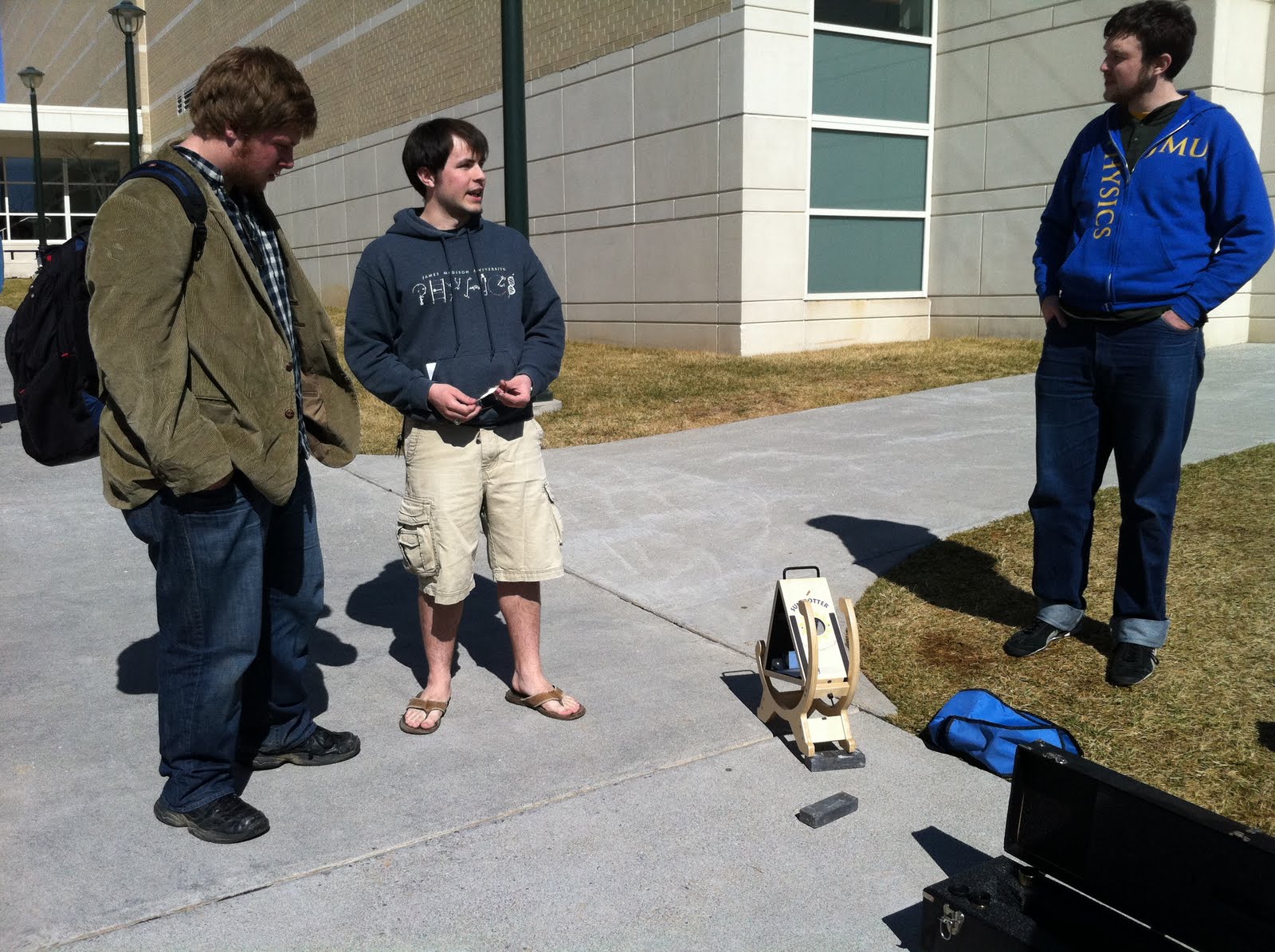
    Yesterday, on that superbly sunny 1st of March, one of the side walksof JMU's campus got the rather rare chance to host astronomy students busy at work and eager to set up some solar observations. Although no solar storm was expected and the sunspot activity was quite mild, the excitement was high for playing with JMU's Physics and Astronomy Department Coronado solar telescope (with its sheltering H-alpha filter) and a Sunspotter (the safest solar telescope human beign ever invented). The Astr221 students saw for themselves the active Sun (sunspots and flares), and attempted to present this phenomenon to as many of their JMU colleagues as would venture on the (our!) side walk during that noon hour.
    The Astr 221 classmates Thomas Redpath (senior), Kyle Eskridge (sophomore), and Andrew Rowe (sophomore) estimate that they were able to explain various things about energy production in the core of the Sun or about the origin and properties of the sunspots to at least 15 students who were brave enough to spend a few minutes with us on their way to or from their classes. Senior Collin Wilson happily joined us initially for a few minutes, but as it turned out, he found it impossible to leave us alone with the Sun.

    Many thanks are due to Sean Scully for his help with finding the best spot for the observations, recalling that counterweights are needed to stabilize the telescope and for finding such weights in a fashionable time. He claims to be rewarded by the sight of his colleague(Anca Constantin; the Astr221 instructor)'s crazily enthusiastic efforts to convert every single passer-by into a scientist.

    Sunday, February 27, 2011

    A Banner Recruiting Season

    As of the last update from Dr. Staib on Saturday afternoon, we have set a new record of 48 students scheduled to visit to sit for the scholarship exam. This exceeds our previous record by five, give or take.

    Although there is another week of visits, it seems that our big day was Saturday (2/26) when 10 prospective students and their parents attended.

    If you are one of those who wants to come and have not yet scheduled your visit, time's a'wastin'! It is much to early to know if the record turnout will lead to any increase in the freshman class of 2011. However, it is clear that we will have another strong class with many excellent students.

    Thursday, February 24, 2011

    Two planets found sharing one orbit - New Scientist

    Two planets found sharing one orbit - space - 24 February 2011 - New Scientist

    A summary of 132 launches


    Not only is the shuttle the most complicated machine every built, it has the most complicated lift-off of any rocket.  As you can see in an earlier post, the main shuttle engines are not pointed straight down but rather at an angle to the thrust of the solid fuel rocket. This causes the entire shuttle to lift off at a bit of an angle.

    Then there's the roll maneuver that starts just after clearing the tower. Then the jettison of the external tank and the release of the solid fuel rockets. Beautiful. Breath-taking. Awe inspiring.

    Perhaps the future will bring us an even more amazing piece of technology. Don't hold your breath.

    Salute the end of an era


    Space exploration will never be the same. Many have spent their whole lives knowing that the shuttle Discovery will fly again soon. All good things come to an end.

    Tuesday, February 22, 2011

    Saturday Morning Physics Lecture 5: Let's Get Small: Studies in Nanophysics


    This past Saturday, Feb 19, Profs. Chris Hughes, Scott Paulson and Costel Constantin presented the 5th lecture in our Saturday Morning Physics program. The title of their presentation was "Let's Get Small: Studies in Nanophysics". Approximately 50 students, teachers and parents learned about why nanoscience is so exciting! From hands on activities, like DNA origami which everyone loved, to having the 3 faculty members discuss their science, a great time was had by all. Slides and the video podcast of the event will be available on online at our facebook page and the department's SMP Outreach page.

    Unfortunately, all good things must come to a close. This Saturday, Feb 26 at 9:30AM, Prof. Brian Utter will present the last talk entitled "Jamming, Avalanches, and Unpredictability: Nonlinear Dynamics and Complexity in Granular Flows". In the afternoon, we will have a special treat as Physics & Astronomy Chair, Prof. Steven Whisnant, will deliver the closing talk entitled "Outlook on College/Career Path in Physics". Please join us!

    Thursday, February 17, 2011

    Saturday Morning Physics Lecture 4: Exploring Fundamental Ideas About How Our World Works: Tools and Challenges


    Incredibly, our inaugural Saturday Morning Physics @JMU program is quickly coming to a close! This past Saturday, we had our 4th lecture in our 6 part series. Prof. Kevin Giovanetti gave a great talk on "Exploring Fundamental Ideas About How Our World Works: Tools and Challenges" to a large room of ~50 high school students, their parents, and even a few teachers. :)

    You can find a podcast of his talk (don't miss his exploding pop can demonstration!), presentation slides and photos of the event at our Physics & Astronomy SMP Outreach webpage.

    This coming Saturday, our 2nd last lecture (!) of the series, will feature Prof. Chris Hughes who will talk to us about Let's Get Small: Studies in Nanophysics. Nanotechnology/Nanoscience is one of the really "hot" areas in Physics today so this promises to be a great talk! Please join us this Saturday (Miller Hall, Room 1101) at 9:30 for Prof. Hughes' talk to learn more about this exciting area of research!

    Monday, February 14, 2011

    From Granular Flows to X-ray Emitting Pulsars


    It may sound like a journey, and it may in fact be, but you are going to guess how that is done. Here, you're going to read about the astronomical end of this journey, which, may be a beginning in itself. Richard Knoche, one of our PandA seniors, sent us some notes on what he experienced while attending the 217th Meeting of the American Astronomical Society (AAS), the largest astronomical meeting where the science in hot, the schmoozing is essential, the students are promising. And all in spite of the fact that during the semester/class time, Richard's been concentrating on understanding various properties of the granular flow at JMU. Which only says: summers are special, and they deserve to be treated well, i.e., with some astrophysics.

    Like one of those who saw the light, Richard undertook an REU appointment in astrophysics at NASA Goddard last summer. His enthusiasm and hard work won him a trip to Seattle to present his results, to meet other astronomy aficionado undergraduate and graduate students, and surprisingly even for him, to get new ideas about research he might pursue in the future:

    Last summer I was lucky enough to have an internship at NASA Goddard. I worked on two projects there, one studying gamma ray bursts and the other studying x-ray emissions in pulsars, and was awarded a travel grant for my work. My research advisor and I decided it would be best to use the grant to present some of my findings at the national AAS conference in Seattle, so at the beginning of this semester I took a week off from school and flew across the country to my first big conference.

    I wasn't sure what to expect before I arrived in Seattle, and was pretty nervous about how my presentation would go. Luckily, I had a day off before I presented so I had plenty of time to walk around and attend some of the talks and poster sessions. For the most part the talks covered subject matter that was a bit over my head, but it was still exciting to hear about the cutting edge research that was going on in astronomy. Even more exciting was the people I got to meet. I was able to meet plenty of other undergraduate students, current graduate students, professors, and even a Nobel Laureate; and each person I met had interesting and useful information to share about research, graduate school, or the conference itself.

    The next day my presentation went off without a hitch. Foot traffic in the poster area was very busy, and there were plenty of people who seemed interested in my research. I was expecting the poster session to consist of me giving a similar presentation to people all day, and not getting much out of it for myself. However, I found that the researchers at the conference were much more engaging. Although there were some tough questions asked, there were plenty of people that shared insight into what would be interested to look into next with my research.

    Overall the conference was a great experience. I learned a lot about graduate school, researching in astronomy, and even what I could do next with my own research. I'd definitely recommend going to a conference like this if any students are offered the opportunity.

    Here is the big smile that proves what's been said above is true:


    Sunday, February 13, 2011

    Recruiting season begins

    This week begins the annual freshman recruiting season for PandA. Those of you that have been through the process will remember it well: the phone calls from Dr. Staib (still doing our recruiting after all these years!), the visit, the scholarship exam, lunch with faculty and the department tour.

    Between now and the first week of March we will host perhaps 40 prospective students and their parents. Not all will choose to attend JMU. Our job is try to convince that they should be here. The range of research options and opportunities for getting involved in the freshman year is central to our pitch. We are the place to be in Virginia.

    The university is continuing the Madison Achievement Awards (MAS) and the Second Century Scholarships and the department continues the Presidential and Gordon Scholarships. Altogether we have about 14 scholarships total to award! Given the size of our typical freshman class, this means that nearly 1/2 of the freshman class will be on scholarship. This is an amazing ratio.

    We're looking for the best and brightest for in-state and out-of-state (the MAS are targeted to out-of-state students). The number and quality of applicants in recent years have make a clear impact on our program. These scholarships are having a clear effect. This year we will continue on this path of growth and improvement.

    In the histogram at the right is distribution of the number of graduates from undergraduate only physics departments in the US for the 2009-2009 school year. This data is the most recent was collected by the American Institute of Physics. The largest department graduated 30. In 2010, we graduated 21. This growth and the steady improvement in the quality of students (both due, in part, to the number and quality of scholarships we have to award) mean we are slowly but surely on track to be one of the very larges undergraduate physics departments in the country.

    Saturday, February 05, 2011

    Saturday Morning Physics Lecture 3: A Tale about Fundamental Ingredients of Our Universe and the Interactions Between Them


    We are now half way through our inaugural 6-lecture program, Saturday Morning Physics at JMU!!

    This morning Prof. Niculescu of JMU Department of Physics and Astronomy talked to us about "Building Blocks for the Budding Scientist: A Tale about Fundamental Ingredients of our Universe and the Interactions Between Them".

    Podcast and pictures to follow!

    Why Study Physics?

    The American Physical Society has a very good web page that gives lots of reasons why it is to your advantage to study physics. I'll just highlight one here. The one you are thinking about. Money.

    Consider this:
    You will note that the starting salaries for physics majors is very competitive with all the highest starting salaries in fields like chemical and electrical engineering. Fields like chemistry and biology are distinctly lower. This makes physics an especially advantageous choice for those who are considering medical school. Even if you don't get in (and physics will improve your chances of doing this), you've have better prospects of a high paying job starting with physics.

    You can learn more about what's good about a physics degree at the APS education web site.

    Wednesday, February 02, 2011

    Saturday Morning Physics Lecture 2: Unveiling Star Formation

    This past Saturday, Professor Harold Butner gave a fascinating talk entitled "Tracing the Invisible: Star Formation Behind Closed Curtains" as part of the inaugural Saturday Morning Physics program. Well over 50 participants and their parents attended the talk and the accompanying planetarium show "Black Holes: The Other Side of Infinity". The lecture was taped and will soon be available to be streamed online at: http://csma31.csm.jmu.edu/physics/Public/saturday.html

    You can also find photos from the event and Prof. Butner's slides at the same location.

    This upcoming Saturday, Feb. 5, Prof. Gabriel Niculescu will deliver lecture 3 entitled "Building Blocks for the Budding Scientist: A Tale about Fundamental Ingredients of our Universe and the Interactions Between Them". You can find more details about this lecture and the remaining SMP lectures at http://csma31.csm.jmu.edu/physics/Public/saturday.html as well as via our Facebook page at http://www.facebook.com/SMP.JMU

    Shanil Virani

    Sunday, January 23, 2011

    The First Saturday Morning Physics

    On Saturday morning, we had our first installment of of the Saturday Morning Physics. Adriana Banu described nuclear physics for a full crowd of folks.

    Many students were accompanied by their parents and many of the parents joined them in the lecture. We are excited to have some many people interested in seeing what we are up to in our research.

    Saturday, January 22, 2011

    How Often Do Giant Black Holes Become Hyperactive?

    If you've ever wondered how often the biggest black holes have been active over the last few billion years, here are some answers.

    Last December (yes, we're a bit late with these news, but they are still hot...) the (NASA) press released a story on "How Often Do Giant Black Holes Become Hyperactive?" (http://www.nasa.gov/mission_pages/chandra/news/10-169.html)

    Here you can read about how supermassive black holes grow and about possible implications for how the giant black hole at the center of the Milky Way will behave in the future. The conclusions are based on the first direct determination of the fraction of field galaxies in the local Universe that contain active supermassive black holes, which is important to know because this is directly related to how often these giant black holes flare up, since that's when they go through a major growth spurt.

    Anca Constantin, one of the lively JMU's astropysicists, is a co-author on the paper presenting the science being this story. So, no wonder you are hearing about these fantastic results from this blog.

    Wednesday, January 19, 2011

    Making Stuff NOVA Show Premiers Tonight on PBS

    Tonight at the PBS NOVA will kicking off the Making Stuff series with the first episode: Stronger!
    David Pogue takes viewers on a journey into the world of materials science. Dr. Costel Constantin of JMU was part of Material Research Society's NOVA committee which helped with scientific ideas throughout the production of the show.
    Enjoy it!

    Monday, January 17, 2011

    Programming the “specialist-of-all-trades” in the PHYS 372 class

    Jack-of-all-trades would simply not work. With a single microcontroller, one can control sophisticated machines that perform highly specialized jobs. With hard work and passion, last semester students from PHYS 372 class programmed PIC 16F877 microcontrollers by using EasyPic6 development boards. This movie shows some of our students' projects.

    Friday, January 14, 2011

    Biomaterials research at JMU-Physics

    The Biotechnology Journal has just accepted a new paper from the NCSU-JMU collaboration working on engineering the properties of biomaterials using atomic layer depsition. The new paper is entitled "Atomic layer deposition of titania on cellulose acetate for enhanced hemostasis". The contribution from JMU comes from Dr. Scarel and her group. Dr. Scarel has performed infrared spectroscopy analysis of the samples before and after the ALD treatment.

    Sunday, January 09, 2011

    Spring Semester is Upon Us

    On Monday Morning, bright and early, spring semester 2011 begins. We'll soon have snow days to make up (forecast for Tuesday, perhaps) and exams to prepare.

    Another fun time of teaching and learning physics.

    Thursday, January 06, 2011

    What happens when there are no classes

    Some may wonder what happens on a university campus when the students aren't around. Here's the answer  to this big question. CONSTRUCTION!

    Standing in Kim's office and looking out the window, this is what we see. The new Biology building is moving right along. The contractor has taken the opportunity with no students to do some underground plumbing and currently have the several trenches dug in "our front lawn". In the photo is the largest of the holes.

    We're told this will all be covered by Monday morning so the buses can park and the students can get to class.

    For those still visiting campus, you'll notice that the steel on the building itself has all gone up since final exams.

    Sunday, December 26, 2010

    Lunar Eclipse

    According to Wikipedia (that source of all things true and correct),  the eclipse on December 21, was the first total lunar eclipse to occur on the day of the Northern Winter Solstice (Southern Summer Solstice) since 1638, and only the second in the Common Era. Not sure that the timing makes it special, but it sure make it rare.

    Here is a time-lapse video of the eclipse for those who could not stay awake or, like me, were in a cloudy spot.


    You earn extra points for explaining the ruddy color of the moon during the totality and why it is not simply black (invisible).

    Monday, December 20, 2010

    What to do with a physics degree

    Even if you know that you like physics, this can be a confusing question to answer. Fortunately, there are resources available to help you work through this decision.

    And for a much broader view, check out Engineering, Science and Math Careers for an extensive list of possibilities to explore.

    There are tons of career options and the list is growing as our society becomes more technically based. Physics (and Astronomy) are excellent choices for a broad range of science careers.

    PandA@JMU is the very best place to start this journey. But you knew that, right?

    Saturday, December 18, 2010

    Fall semester has ended

    Today was the December graduation ceremony. The house was full and everyone was happy and cheering. Three of our majors graduate this semester and we are indeed proud of them.

    We're at the halfway point of the academic year. At this point we pause to catch our breath and celebrate the season with friends and family. We here in the PandA wish everyone a safe and happy holiday.

    In January we are all busy again. Dr. Butner has a full schedule for the spring seminar series already. Among the visitors are James Green the Director of Planetary Science at NASA and Gary White the Director of the Society of Physics Students.

    The Saturday Morning Physics program promises to be exciting. Enrollment is at capacity (about 60, last check) and we are preparing for bringing the excitement of physics to many students, parents and teachers in the region. The high school physics video contest is well advertised and we already know of several schools in the area that will have students entering.

    We have many dedicated students working on research with our faculty preparing for the spring symposium (last year's is here). Several students will also be using the symposium as a preparation for taking their work on the road to regional and national conferences. We will recognize our outstanding students at the annual honors banquet on Wednesday April 6.

    The first installment of our planned applied nuclear physics track will be offered this spring. Dr. Banu will teach a new course in introductory nuclear science and a lab to go with it. The new Madison Radiation Laboratory (the old RMH Cancer Center) is slowing beginning to take shape as we start through the licensing process so we can the turn on our linacs and x-ray machine.

    A busy year ahead, indeed. Stay tuned as we move forward with these exciting programs.

    Oh yeah. I forgot. We will also be teaching.

    Sunday, December 12, 2010

    ...and a good time was had by all!

    This year's holiday party was another success in a long line of successes. Everyone had pizza and sodas and great (read=silly) gifts were exchanged by the seniors and the faculty. There was dancing by Santa and his helpers (above, left to right: Gabriel Niculescu (Santa), Art Fovargue (Chief Elf), Adriana Banu (Mrs. Santa), and Kevin Giovanetti(Elf)) and great merriment. The senior video was well done and everyone had a good laugh.

    The pizza and sodas were eagerly consumed.

    See all the photos here.

    Space Shuttle

    For those of you out there that are devoted space shuttle fans, here's the video for you. I have always thought that the lift off was a graceful and dramatic event with the roll maneuver happening just after it clears the tower. On this lengthy video you can see it in slow motion.

    The multiple camera angles and the high-speed photography are truly impressive. Enjoy this farewell to the end of an era.


    PandA will soon have it's own memento of this amazing machine and the exploration it made possible. We have ordered a tile from one of the decommissioned shuttles. The thermal properties are still difficult to conceive even after all these years of seeing it work.

    Wednesday, December 08, 2010

    USA Science and Engineering Festival 2010


    Thousands of people gathered on the National Mall (Washington, DC) for the USA Science and Engineering Festival, which ran from Sunday, Oct. 10, through Sunday, Oct. 24. On October 24, Dr. Costel Constantin together with seven physics major and one nursing major volunteered with both Nanoscale Informal Science Education Networked/Material Research Society, and PBS WGBH/NOVA Making Stuff booths. The students who come with me are Anita Vincent-Johnson (Physics), Anthony Chieco (Physics), Jimmy Hauver (Physics), Cheyenne Shafte (Physicss), Denise McKaig (Physics), Alexandra Iuga (Physics), Christina Hanks (Physics), and Emily Schofield (Nursing). Our students explained how the properties of materials change with size. After the event, we were fortunate to be invited to the radio show “STEM SELLS” hosted by Prof. Brian Utter, and Prof. Mark Mattson from Physics and Astronomy Department. Related to this event, there is an article published in the Madison Magazine titled "Lego robotics, hydrogen cars, geospatial tech on the D.C. Mall". The article can be found at page 14, in the latest winter 2011 edition of Madison Magazine. Here I am carbon-copying the paragraph in which we were mentioned within the article “Dr. Costel Constantin (Physics and Astronomy) volunteered with both Nanoscale Informal Science Education Networked/Material Research Society and PBS WGBH/NOVA Making Stuff booths, with the help of JMU students Anita Vincent-Johnson (Physics), Anthony Chieco (Physics), Jimmy Hauver (Physics), Cheyenne Shafte (Physicss), Denise McKaig (Physics), Alexandra Iuga (Physics), Christina Hanks (Physics), and Emily Schofield (Nursing). They explained properties of carbon nanotubes, nano sands, and strengths of nanofabrics to Festival visitors.” I would like to thank all our student volunteers for doing a great job.

    Tuesday, December 07, 2010

    A New Look

    We've finally upgraded the blog design. Hope you like it.

    Annual Holiday Party is coming Friday

    This Friday (December 10), we will again have a visit from the jolly fellow with the white beard in room 2122 at 2:15 as we celebrate the end of the semester in the department holiday party. You realize of course that the jolly fellow to which I refer is D. Gabriel Niculescu in disguise, right? You didn't really think it was Santa did you?

    Come if you can. There'll be pizza, sodas and a good time have by all.

    Sunday, December 05, 2010

    This is what happens when you aren't a physics major.

    As you may recall, in a previous post to this blog the strong preparation for medical school that a physics degree offers was pointed out. Let me see if I can add a little fuel to this fire.

    In the journal in Diabetes Care we find the following article:

    A mathematical model for the determination of total area under glucose tolerance and other metabolic curves. M M Tai 

    Diabetes Care February 1994vol. 17 no. 2 152-154
    From the title it sounds suspicious  already. Check out this excerpt from the abstract:
    OBJECTIVE--To develop a mathematical model for the determination of total areas under curves from various metabolic studies. RESEARCH DESIGN AND METHODS--In Tai's Model, the total area under a curve is computed by dividing the area under the curve between two designated values on the X-axis (abscissas) into small segments (rectangles and triangles) whose areas can be accurately calculated from their respective geometrical formulas. The total sum of these individual areas thus represents the total area under the curve. 
    It seems the M. M. Tai has re-invented that process all physics (and math) majors learn in their second semester of calculus...we call it integration. Sort of sounds like the trapezoidal rule, eh? Clever that the author names the "model" after himself, isn't it?

    While it is true that a physics major who becomes an MD would never try to publish this since it is old hat and we all know this, just think of all the new things you could publish: the energy required to lift a patient is proportional to the patient's mass and the change in height, the rate of flow through a hypodermic is proportional to the pressure applied to the piston, the time rate of change of a disease can be determine by the an examination of the change between two successive measurements. The list is endless. Why, you could publish your way into tenure at any hospital, no sweat. Just think of the wondrous new effects you could name for yourself!

    Did I mention that this paper has 75 citations?