Sunday, August 26, 2012
The 2012-2013 Academic Year Begins
So, here we are again.
Beginning of the school year and there are once again a few new faces in the crowd. For those of you who haven't visited us lately (and why aren't you stopping by?!), here's the key in order from left to right...
Front row:
Adriana Banu, Harold Butner, Sean Scully, Keigo Fukumura, Anca Constantin, Steve Whisnant
Second row:
Kim Emerson, Costel Constantin, Klebert Feitosa, Elizabeth Jeffery, Ioana Niculescu, Gabriel Niculescu
Third row:
Art Fovargue, Shanil Virani, Jarrett Lancaster, Kevin Giovanetti, Herb Slade, Chris Hughes
and hiding in the back;
Giovanna Scarel and Mark Mattson
Missing here are Brian Utter who is on sabbatical in Germany this year and Scott Paulson who is taking his Research Semester this fall and is working at UVa.
And so, with smiling faces (most of us any way), we greet the new year and prepare to excite our record entering class of 36 new physics majors!
Sunday, August 05, 2012
7 Minutes of Terror: Mars Curiosity Lands TONIGHT!
On Saturday, November 26 at approximately 10:02AM (EST), Mars Science Laboratory (MSL) lifted off from Cape Canaveral Launch Complex 41 en route to Mars. After more than 8 months in flight, MSL arrives very LATE tonight! The SUV-sized rover it is carrying, called Curiosity, is expected to touchdown on the surface of the Red Planet at 1:31AM (i.e., early Monday morning). After traveling 566 million kilometers, imagine a remote-controlled Cadillac Escalade landing in a dust storm.
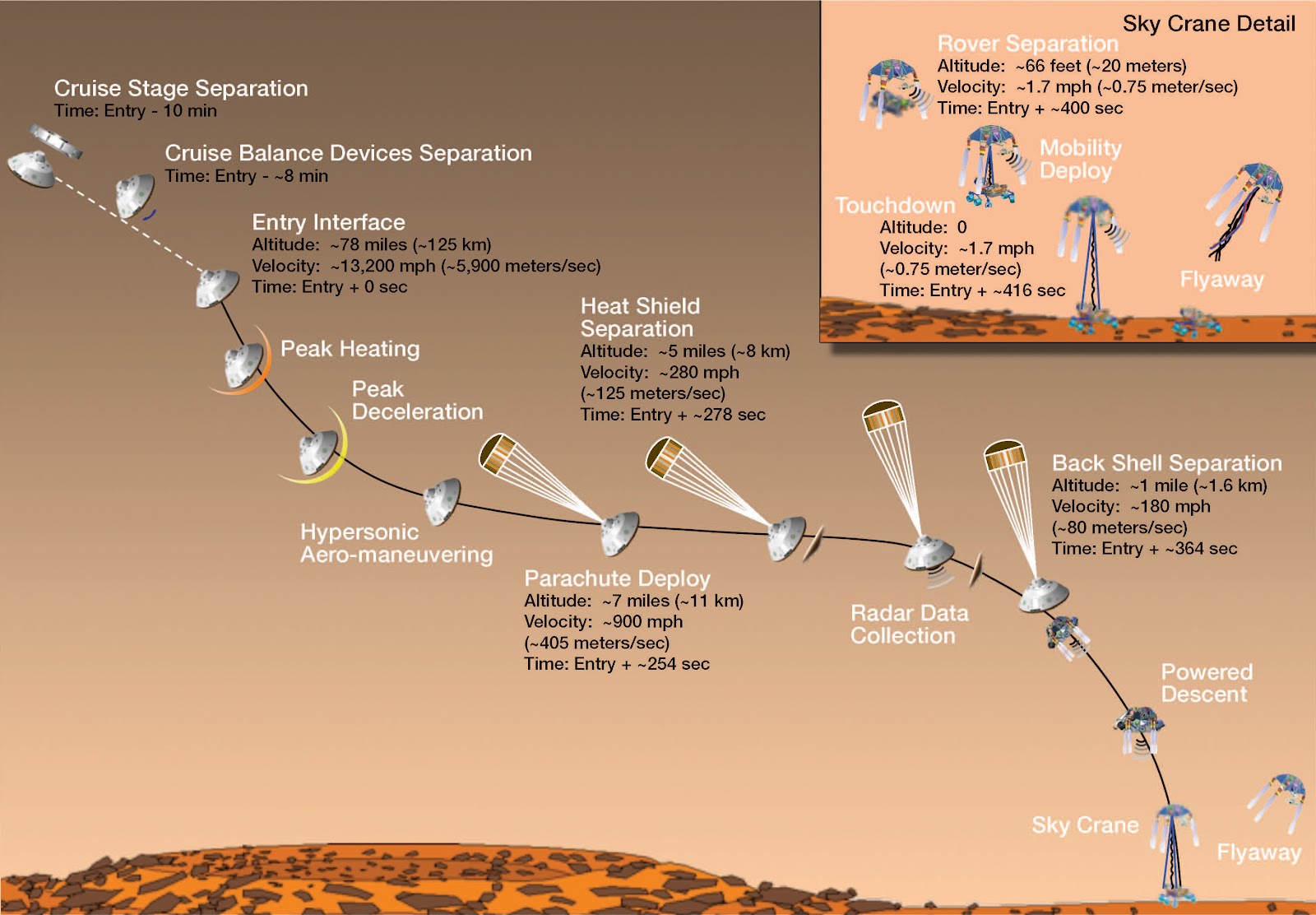
This will be no easy feat. In fact, arriving and surviving touchdown would be an enormous scientific and engineering accomplishment. The landing sequence is incredibly risky (see image and 7 Minutes of Terror) and of Mankind's 39 missions to Mars, we've been successful only 15 times. I fully expect very late tonight to be the 16th time we've been successful in landing on Mars but it is important to be aware of the risk of failure and to recognize the extraordinary accomplishment if successful.
Despite the poor odds, we continue to go. Why? Mars Curiosity will open a new opportunity to study the habitable environment of the Red Planet. If you have come to the John C. Wells Planetarium recently, you will have heard me say during my star talk that in my opinion, the greatest discovery in science would be the discovery of life outside of Earth. While NASA's Kepler mission has done an extraordinary job discovering exoplanets, some even in the so-called "habitable zone" where water (should it exist) would be in its liquid form, the best evidence of life outside of Earth may come from within our Solar System, Mars in particular.
Previous missions to Mars has confirmed the hypothesis that Mars had liquid water in its past. But does Mars host life currently? Did it in the past? The answers to these questions have been inconclusive so far. This is where Mars Curiosity comes in. It is landing in Gale Crater, a carefully-chosen landing site after 5 years of analysis. This ~93 mile-wide-crater is an ancient impact basin for which there is very good evidence to suggest an ancient river once flowed through it. It is also a site with mineral-rich terrains and a mountain right in the middle where Curiosity will spend most of its time working to learn if it had an environment where microbes may have thrived.
This story begins tonight! Join me on twitter tonight where I will provide updates and commentary. You can watch NASA TV's feed online if your cable tv carrier does not carry it. Note that once Curiosity lands, it will be 14 minutes for us to receive telemetry that touchdown was successful and another 14 hours to get the first high resolution images that Curiosity will snap from its landing site.
My 2-year old son and I watched the launch on that Saturday morning after Thanksgiving Day and I am going to try to keep him up tonight for this historic landing!
This will be no easy feat. In fact, arriving and surviving touchdown would be an enormous scientific and engineering accomplishment. The landing sequence is incredibly risky (see image and 7 Minutes of Terror) and of Mankind's 39 missions to Mars, we've been successful only 15 times. I fully expect very late tonight to be the 16th time we've been successful in landing on Mars but it is important to be aware of the risk of failure and to recognize the extraordinary accomplishment if successful.
Despite the poor odds, we continue to go. Why? Mars Curiosity will open a new opportunity to study the habitable environment of the Red Planet. If you have come to the John C. Wells Planetarium recently, you will have heard me say during my star talk that in my opinion, the greatest discovery in science would be the discovery of life outside of Earth. While NASA's Kepler mission has done an extraordinary job discovering exoplanets, some even in the so-called "habitable zone" where water (should it exist) would be in its liquid form, the best evidence of life outside of Earth may come from within our Solar System, Mars in particular.
Previous missions to Mars has confirmed the hypothesis that Mars had liquid water in its past. But does Mars host life currently? Did it in the past? The answers to these questions have been inconclusive so far. This is where Mars Curiosity comes in. It is landing in Gale Crater, a carefully-chosen landing site after 5 years of analysis. This ~93 mile-wide-crater is an ancient impact basin for which there is very good evidence to suggest an ancient river once flowed through it. It is also a site with mineral-rich terrains and a mountain right in the middle where Curiosity will spend most of its time working to learn if it had an environment where microbes may have thrived.
This story begins tonight! Join me on twitter tonight where I will provide updates and commentary. You can watch NASA TV's feed online if your cable tv carrier does not carry it. Note that once Curiosity lands, it will be 14 minutes for us to receive telemetry that touchdown was successful and another 14 hours to get the first high resolution images that Curiosity will snap from its landing site.
My 2-year old son and I watched the launch on that Saturday morning after Thanksgiving Day and I am going to try to keep him up tonight for this historic landing!
Saturday, August 04, 2012
The 2012--2013 Academic year
This year's incoming class is a new department record: 34 freshmen and 2 transfers for a total of 36. In addition, one of the freshmen is our first ever Dingledine scholar, Devin Buenemeyer. This is a real honor for the department. We are extremely proud of her and delighted that she has chosen physics and our department. The graduating class this year was small (13) but next year's promises to be sizable (20 or more). With the addition of Shanil Virani as our recruiter, we have great expectations. Shanil has many excellent idea and a tremendous amount of energy. Jon Staib has passed the baton with a clear lead for the department and Shanil is ready to run (forgive the Olympics metaphor). Don't be surprised if remarkable things happen.
We have a strong incoming class this year. We have some very excellent students as upperclassmen. We are growing and getting better.
This year we add Keigo Fukumura and Jarrett Lancaster. Elizabeth Jeffery is staying with us for another year or two and searches to fill open positions are going to commence in a month or two. Costel Constantin is moving into a tenure track position. Brian Utter is going on sabbatical in Germany and Scott Paulson is taking the Research Semester in the fall to spend time in Charlottesville. Both are moving their research interests towards biological systems.
The department reached a new high this year in external funding with a total of over $4.77 million. The only tenure track faculty without external funding in the department are the new folks, Costel and Keigo, and they will be funded soon at the rate things are going. Such vigorous research is rare in undergraduate departments and actually not all that common in research institutions We are a young department with only three faculty (Kevin Giovanneti, Chris Hughes and Mark Mattson) hired before 2001.
We are still pushing to open the Madison Radiation Laboratory asap. and proposals are being written to obtain money for experiments there. Discussions with the university administration is continuing.
Every year is better that the last and this year is no exception.
Come visit.
Be part of the amazing PandA@JMU.
We have a strong incoming class this year. We have some very excellent students as upperclassmen. We are growing and getting better.
This year we add Keigo Fukumura and Jarrett Lancaster. Elizabeth Jeffery is staying with us for another year or two and searches to fill open positions are going to commence in a month or two. Costel Constantin is moving into a tenure track position. Brian Utter is going on sabbatical in Germany and Scott Paulson is taking the Research Semester in the fall to spend time in Charlottesville. Both are moving their research interests towards biological systems.
The department reached a new high this year in external funding with a total of over $4.77 million. The only tenure track faculty without external funding in the department are the new folks, Costel and Keigo, and they will be funded soon at the rate things are going. Such vigorous research is rare in undergraduate departments and actually not all that common in research institutions We are a young department with only three faculty (Kevin Giovanneti, Chris Hughes and Mark Mattson) hired before 2001.
We are still pushing to open the Madison Radiation Laboratory asap. and proposals are being written to obtain money for experiments there. Discussions with the university administration is continuing.
Every year is better that the last and this year is no exception.
Come visit.
Be part of the amazing PandA@JMU.
Sunday, July 08, 2012
Washington Post says there are no science jobs, but...
The Washington Post has an article today about job prospects for scientists. The article, U.S. pushes for more scientists, but the jobs aren’t there, tries to paint a doom and gloom picture of the job prospects for scientists. It points to neuroscience and pharmaceuticals as places that are no longer hiring PhD's and that
Catch that? 1 -2% unemployment for physicists and physicians. In an economic downturn with overall unemployment of 8.2%? This would be great news in any kind of economy.
So in case you were wondering why an undergraduate degree in physics is the place to start your medical career, this is the reason. Not only is physics a great career choice, it is an ideal "plan B" for charting a path to medical school. What happens if you don't get into medical school? Only good things if you have a physics degree. An undergraduate degree in physics puts you in a place to get a good paying technical job or pursue graduate work for an even higher paying job. And it looks like your chances of finding that good paying job are 98-99%.
Physics. Still the best deal in town.
it’s questionable whether those youths will be able to find work when they get a PhD. Although jobs in some high-tech areas, especially computer and petroleum engineering, seem to be booming, the market is much tighter for lab-bound scientists — those seeking new discoveries in biology, chemistry and medicine.Sounds pretty nasty out there, doesn't it? Buried on page two is, however, the key point:
Two groups seem to be doing better than other scientists: physicists and physicians. The unemployment rate among those two groups hovers around 1 to 2 percent, according to surveys from NSF and other groups. Physicists end up working in many technical fields — and some go to Wall Street — while the demand for doctors continues to climb as the U.S. population grows and ages.
Catch that? 1 -2% unemployment for physicists and physicians. In an economic downturn with overall unemployment of 8.2%? This would be great news in any kind of economy.
So in case you were wondering why an undergraduate degree in physics is the place to start your medical career, this is the reason. Not only is physics a great career choice, it is an ideal "plan B" for charting a path to medical school. What happens if you don't get into medical school? Only good things if you have a physics degree. An undergraduate degree in physics puts you in a place to get a good paying technical job or pursue graduate work for an even higher paying job. And it looks like your chances of finding that good paying job are 98-99%.
Physics. Still the best deal in town.
Wednesday, June 27, 2012
Don Chodrow Memorial Scholarship Endowment
On behalf of the friends, current and former students and colleagues of Dr. Chodrow, a scholarship in his honor has been created. The Don Chodrow Memorial Scholarship Endowment will provide resources annually for one or more outstanding undergraduates in the Department of Physics and Astronomy.
To be eligible for this scholarship, a student must have a cumulative grade point average of 3.5 or higher and at least four semesters of study. By selecting from among our very best junior and senior physics majors, we honor the tradition of excellence for which Don was such a strong advocate both in and out of the classroom.
To create an endowed fund so that this scholarship is permanent, we must raise at least $25,000 by 2017. You may support this scholarship either by check or by giving on-line. Complete information is found on the web here.
Recognize the difference that Dr. Chodrow made in your life by considering a contribution to this fund. By "paying it forward" you can help us carry on his tradition of student centered education of the highest quality.
Thursday, June 21, 2012
Don Chodrow
Physics and Astronomy has lost Don Chodrow to an automobile accident. On Monday June 18th, Don was involved in a single car accident on I-81. He was on his way to teach Phys 150 in summer session. He was flown to UVA Medical Center, but never regained consciousness. After organ donation, he was removed from life support on June 20th. One of the bright lights in our department has gone out.
The family asks that no flowers be sent. Donations may be sent to Temple House of Israel, P.O. Box 1412, Staunton, VA 24402, or to the Don Chodrow Memorial Scholarship Endowment. We are creating a scholarship in Don's name to continue his long tradition of putting our student's education first.
Don was such a big part of our department for the past 32 years that it is impossible to understand what we will be without him. He was always a strong voice for high quality education for all of our students. As the long-time instructor of advanced mechanics (Phys 340), he guided our majors toward understanding physics deeply and broadly. His dedication to teaching is without parallel. He eagerly taught any and every course offered to him. Don was routinely in front of classes that spanned the spectrum in our department, from GSCI 101 to second-semester quantum mechanics. He was a leader in curriculum development, chairing the Curriculum and Instruction Committee for more than a decade. He guided many students to graduation, successful careers, and graduate school in his role as an academic advisor. Our majors revered him.
His presence also filled the department in a dozen small ways. He was always quick with a laugh or a joke so bad you had to laugh in response.
Don always had a hand on the rudder of the ship that is Physics and Astronomy. We will continue in his absence for he would have it no other way, but without his steady hand our direction is just a bit less well-defined.
We are thankful for all that was gentle and noble in his life. We will miss you, dear friend.
The family asks that no flowers be sent. Donations may be sent to Temple House of Israel, P.O. Box 1412, Staunton, VA 24402, or to the Don Chodrow Memorial Scholarship Endowment. We are creating a scholarship in Don's name to continue his long tradition of putting our student's education first.
Friday, May 25, 2012
The Science enabled by Photon Sources: Local interest in Virginia
On May 16 2012 the Workshop on "The Science enabled by Photon Sources: local interest in Virginia" took place at JMU. Several Faculty members of the Department of Physics and Astronomy were in the Organizing Committee (Dr. Whisnant, Dr. Hughes, and Dr. Scarel). Dr. Hughes, Dr. Utter, Dr. Feitosa, Dr. C. Constantin, and Dr. Scarel were among the presenters.
The Workshop gave an ample view of the vast capabilities of photon Sources in various fields of Science. Dr. Ward Plummer (Louisiana State University), one of the keynote speakers, gave a historical picture of the evolution of Photon Science and offered an overview of the possible developments. His talk touched topics related to physics and materials science, in particular related to superconducting materials. The need of photon sources to improve the research in materials science was illustrated in the presentations of various JMU faculty members, who underlined the need for better imaging techniques, and more sensitive tools to perform chemical analysis in soft and hard materials. Dr. Peter Abbamonte (University of Illinois – Urbana Champaign), another keynote speaker, illustrated how the mystery of the lack of a band gap in graphene was solved using high energy photons produced in a storage ring. Other presenters from JMU and from other Universities in Virginia and Washington DC described the power of photon sources in understanding phase transitions in oxides, collective excitations, and the properties of photon themselves. Dr. Stefan Vogt (Argonne National Laboratory and Northwestern University), the third keynote speaker, succeeded in convincing that photon sources offer enormous possibilities in the fields of biology and medicine. A new JMU Chemistry faculty member supported the view. Other presentations illustrated new fascinating mysteries awaiting to be investigated with the powerful photon sources in the fields of environmental sciences, electronics and spintronics, and mentioned the technical challenges associated to the process of data acquisition.
A radio interview of Dr. Scarel aired on May 11 2012 can be found at http://wmra.org/post/physicist-giovanna-scarel
Here is Dr. Utter ....
Here is Dr. Abbamonte ...
... and here is Dr. Scarel
Saturday, May 19, 2012
2nd Annual Video Contest
Judging for JMU physics' 2nd annual video contest is underway. If you want to take a look at some of the videos high school students from Virginia and Maryland have entered, look here:
http://www.youtube.com/user/drscottpaulson?feature=mhee
Details about this year's contest are on the department webpage,
Thursday, April 26, 2012
Why the Engineering, Computer Science Gender Gap Persists
As indicated in an article published recently in Scientific American the answer to this question is yet anybody's guess...
Monday, April 23, 2012
Physics weekend affairs again: the CAA Undergraduate Research Conference
The weekend of the April 13th-15th , I [Jimmy Corcoran, a junior physics major] had the opportunity to participate at the Colonial Academic Alliance (CAA) Undergraduate Research Conference [at Old Dominion University in Norfolk]. Initially I wasn't sure I was skeptical about whether or not I would enjoy the experience, but I was quickly reassured. There were events spaced out throughout the entire weekend, enough so that you always knew you were kept in an academic mindset, but not so many that you felt overwhelmed and didn't have enough time to relax. Everything over the course of the trip went smoothly, both of the keynote speakers were fantastic speakers and were able to captivate the entire audience, regardless of their academic focus; the spacing out of all of the student presentations, and even all of the meals prepared for everybody were fantastic. Overall I thought it was really a fantastic experience to be around so many people involved in undergraduate research in their respective fields, and also for the opportunity to share the research I've been doing with my peers from the entire CAA.
Jimmy was one of the 3 physics majors representing JMU physics and astronomy undergraduate research (out of a total of 10 JMU selected undergraduates): Jimmy the astronomer was accompanied by Ethan Cummings and Thomas Hoke (both juniors) who presented their findings on some novel materials' behavior at this 10th annual CAA conference. Here are the three of them ( ...musketeers in quest for scientific answers to how the world works):
and here are some details about their presentations, as described in the Madison Scholar.
What can we say, they have their own ways of saving the world!
We heard not once that "they were excellent presenters!"
Monday, April 16, 2012
JMU Physics Helping Out
This weekend students from all around JMU worked on service projects throughout the community as part of the "The Big Event", an annual day of community service. JMU Physics students and faculty give back to the Harrisonburg-Rockingham community in many ways all year long. Some by coaching Little League baseball and others by working with kids to learn about science.
For the second year in a row, Dr. Costel Constantin has organized a NanoDays event for the community at the Explore More Discovery Museum in Harrisonburg. With the help of JMU nanoscientists Drs. Brian Augustine, Kyle Gipson, and Chris Hughes, and a team of local school teachers and JMU students, the doors to the museum were opened for free from 1:00-4:00 pm on Sunday, April 15 for nearly 150 visitors to come learn about the amazing things that happen at the scale of one billionth of a meter. The event even got covered by our local TV station. Plans are already underway for next year's event which should happen some weekend in late March or early April of 2013.
Monday, April 09, 2012
The 2012 Honors Banquet
On April 4, we held the Honors Banquet with 60 faculty, students, parents and friends in attendance. Kim ordered up an excellent selection of the good food we have here on campus. Awards were presented for the best symposium presentations, scholarships and department awards. In addition we have a strong group inducted into the Sigma Pi Sigma.
Congratulations to all. See all the pictures here.
Spring Picnic
We have finally cross over to the other side. This is now what the department picnic looks like!
Invasion of the body snatchers? A paralysis inducing food additive? A new dance? We may never know.
What we do know for sure is that a good time was had and lots of good food was well prepared by Costel Constantin.
More picture found here.
Spring Symposium 2012
The 8th annual Spring Symposium was help in Highlands room of the Festival on March 17, 2012. there was a strong set of papers presented and food and fun was had by all.
The best papers as judged by the faculty this year are:
- Anthony T. Chieco, "Digital Reconstruction of a Real Polydisperse Dry Foam"
- Anita Jo Vincent-Johnson,"Characterizing the Angular Frequency of Radiative Polaritons using Infrared Spectroscopy"
- Anthony Saikin, "Near Infrared Photometry of Nearby DEBRIS Candidates"
Congratulations to all participants. Everyone did a great job.
Sunday, April 08, 2012
And You Thought Learning Only Happened During the Week...
"Meet the Scientist: Saturday Morning Physics at JMU" from the Office of Public Affairs- Check out the link below:
James Madison University - And You Thought Learning Only Happened During the Week...
Saturday, March 31, 2012
Over and Over... cast and solar viewing
Anthony (edible comets), Nathan (black holes & solar viewing), Jimmy (galaxies and sunspotter), Emil (REAL comets), Kyle (solar viewing), in no particular order, got their act together again, or we should say, over and over...cast...
OK, the weather did not cooperate with us yesterday (our planned last Saturday of March), the clouds roamed around the whole morning (sometimes quite menacingly: check out the sky in the pictures), leaving us with basically little chance to show the Sun off through our Coronado. Yep, no flares in sight this time...
Nevertheless, the Breeze (finally) got a handle of us a this event (can you spot the Breeze photographer in the crowd in the above picture?). Until the Breeze article sees the light, here are some snapshots of the goodies of the day:
The sunspotter spotted the clouds and some tree branches, which was still sort of cool... (not only little) people were still fascinated by this little simple device:
The comet making was a big success (again!), from enchanted audience by the setting up process to happy clients, I mean learners about what it takes to produce that comet tail, with both the edible models and the real -non-edible-ones:
(phufff, we were so lucky those meteorites fell on Earth right there near our Market booth and right then -- we're only there 10am-noon)
- anyway, if you're interested in the recipe, you just have to ask. we'll provide it, ~30 million times smaller than the actual one, but for sure with no delay..
wow! look at that tail...
Asteroid and crater production were also quite popular this Saturday:
.... and we also featured guest scientists with us presenting little motors powered by squishy circuits (just so you know how those gyros aboard satellites like the Hubble Space Telescope look like):
All in all, and you can go here to check out some more pictures about today's making of the comets (both types), asteroid and crater involvement, and even some close to successful picking through the telescope.
Monday, March 19, 2012
JMU Physics Students at the National APS Meeting
During the week of February 26, 2012, students John Bridstrup (second right), Anthony Chieco (second left), Nora Swisher (center), and Anita Vincent-Johnson (left), and professor Costel Constantin (right) attended the National American Physical Society (APS) March Meeting in Boston. We presented our research and got to see many other research presentations in materials and quantum related fields. There were vendors there with all kinds of fancy equipment, and Stephen Wolfram was at the Mathematica booth one afternoon! For students, they had a lounge with grad school recruiters and snacks. Along with getting to see great new physics, we also got to explore Boston (seafood lunch, riding the T, etc.). It was a motivating experience and we all had a great time. Nora Swisher
Saturday, February 04, 2012
Saturday Morning Physics 2012
The 2nd annual edition of Saturday Morning Physics, Meet the Scientist is now underway. At the opening session, Dr. Adriana Banu started things off with a discussion of radioactivity. The turnout this year is lager than last year by a good bit. We had 48 attend in 2011 and this year there are 70. More photos of the opening session and the registration are available here.
This program is a big hit with the audience and fun for the faculty. See the web site for SMP for details on this years offerings.
Friday, February 03, 2012
Flares, comets, asteroids...
Yes, once again (following event1 and event2), we took Astronomy to the Market. Last Saturday was the first in the new Spring 2012 series to feature safe solar observations, edible comets, asteroid collisions, along with answers, many answers to your questions about the Universe at the Harrisonburg Farmers Market. The plan is to show off our science corner every last Saturday of the month, so be there if the Sun is up and not behind (too many) clouds!

-the comet making: our own Julia Child (a.k.a. Anthony Saikin) is explaining how the real dirty snow balls (i.e., the real comets) and their beautiful tails can be simulated with just a little passion for cooking and, obviously, for astronomy (not to forget the liquid nitrogen though):


Here are some little snippets of what were we up to:
-watching the solar flares (Nathan DiDomenico at the telescope), most probably related to the raging solar storm that hit us (the Earth) on Jan. 23 (did you feel it? there have been quite a few technical difficulties noted at the radio, as well as some internet glitches):
-in case you worried about it, we (mostly Jimmy Corcoran) did catch the Sun on our sunspotter, with and without clouds:
-our new addition to the group, Jonathan Iredell, oversaw the asteroid experiments:
Wednesday, February 01, 2012
New publication in Applied Spectroscopy
Did you know that the ability of thin oxide films to absorb infrared radiation depends on whether they "sit" on a metal, or on a piece of semiconductor, or on an insulator? Undergraduate student Anita Vincent-Johnson discovered that this is the case by creating computer simulations of the response of the thin films to the infrared radiation. The effort was accomplished under the direction of Dr. Giovanna Scarel and the results were discussed with collaborators of the University of Utah and of Howard University. The team discovered a peculiar substrate sensitive thickness where the effect is particularly evident, as illustrated in the picture on the left. The full reference is A. J. Vincent-Johnson et al., "Effects of metallic, semiconducting, and insulating substrates in the coupling involving radiative polaritons in thin oxide films", Applied Spectroscopy vol. 66 (2), pages 188-197 (2012).
Subscribe to:
Posts (Atom)