Tuesday, May 31, 2011

Summer has begun!

Well, OK, not by the calendar, officially. However, the students appeared today to start the REU (Research Experience for Undergraduates) season and the rest of the faculty funded separately from this materials science program are also up to full speed.

Wednesday, May 25, 2011

Goodbye Spirit


More signs of the changes in the wind...


 Spirit, the scrappy robot geologist that captivated the world with its antics on Mars before getting stuck in a sand trap, is about to meet its end after six productive years.
Spirit has been incommunicado for more than a year despite daily calls by NASA. The cause of Spirit's silence may never be known, but it's likely the bitter Martian winter damaged its electronics, preventing the six-wheel rover from waking up.

See the full story at the NYT. 

Wednesday, May 18, 2011
Monday, May 16, 2011

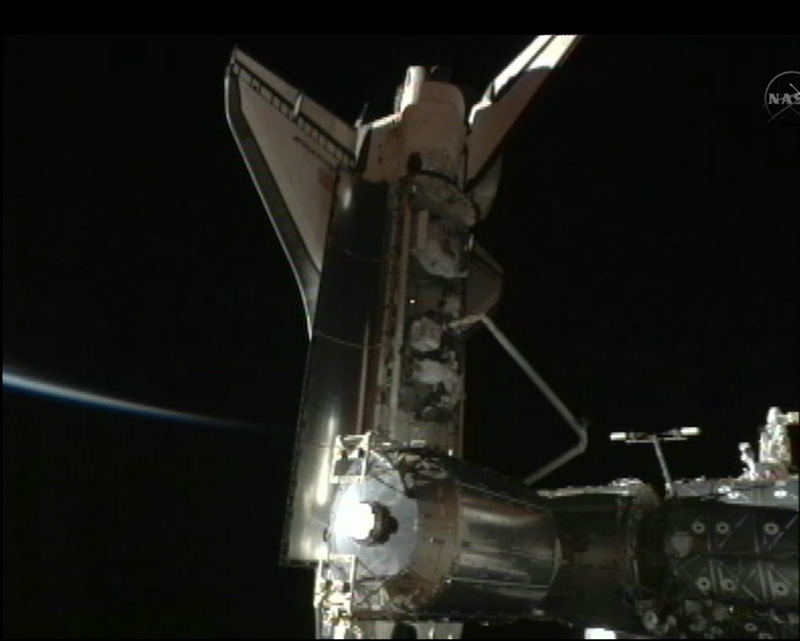
Last Launch of Endeavour


Today the Space Shuttle Endeavour lifted gracefully into space for the last time. A beautiful and impressive event.

From the NASA web site:

The crew members for space shuttle Endeavour's STS-134 mission are Commander Mark Kelly, Pilot Gregory H. Johnson and Mission Specialists Michael Fincke, Greg Chamitoff, Andrew Feustel and European Space Agency astronaut Roberto Vittori. 

During the 16-day mission, Endeavour and its crew will deliver the Alpha Magnetic Spectrometer (AMS) and spare parts including two S-band communications antennas, a high-pressure gas tank and additional spare parts for Dextre.

The final flight honors go to Atlantis on STS-135. The target date for the launch is June 28.

Friday, May 13, 2011

A Better Way To Teach Physics?

Tell someone that you're an 'astrophysicist' and the reaction that I typically get is "physics?! You must be so smart to spend your life studying that subject. I hated physics in school.” Of course, momentary ego-boost aside, what you're really being told is that these otherwise intelligent folks had a frustrating, intimidating experience with a subject I love. So how best to teach physics?

Usually faculty teach physics the way they were taught. Hey, if it was good enough for them, it's good enough for you too! But this traditional "teaching-by-telling" or "sage-at-the-stage" approach just doesn't work! Over the past several years, much research has been done to determine how students learn and how best to teach them (much of it lead by physicists!). The model that has emerged is one in which students are engaged and are active participants in the classroom rather than passive note-takers. One popular method used here at JMU and other institutions is via "clickers" (remote polling devices) to gauge student understanding and to identify misconceptions immediately. The idea is to confront students head-on with their misconceptions so that you can replace the incorrect model they have in their mind with the correct one. Many studies have shown this "intense engagement" to better performance as measured on tests, and one would hope, better understanding. However, as you might imagine, there are many questions that arise in determining whether this active method is truly better than the lecture method.

In a research article published in today's Science, a group of investigators purport to provide a "clean comparison" between the active, student-centered approach versus the traditional, teacher-led approach. The research was conducted by a team at the University of British Columbia in Vancouver and is led by physics Nobelist Carl Wieman. Wieman has devoted the past decade to improving undergraduate science instruction, using methods that draw upon the latest research in cognitive science, neuroscience, and learning theory. What they did was take two large first-year introductory engineering physics classes (one class had 267 students while the other had 271) and teach one section using this "deliberative practice" approach (really just means clickers plus group tasks) while the other section was taught by a "motivated faculty member with high student evaluations" using the standard lecture format. Before the experiment, the instructors for both sections agreed to cover the same unit on electromagnetic waves and on what learning objectives would be covered. A typical 50-min class in the experimental section consisted of a clicker question, instructor feedback, another clicker question, more feedback from the instructor but students can then discuss and change their vote. This was followed by a group task with a demonstration and another clicker question. After 1 week (3 1-hour classes), both sections were given the same 12-question multiple choice test. The students in the "active" section scored more than twice as well as those in the "passive" control section. Just as importantly, 90% of the respondents in the "active" classroom agreed with the statement "I really enjoyed the interactive teaching techniques during the three lectures on E&M waves". So how physics is taught does make a difference!

This is an interesting result and clearly more work is left to be done! To read more about this work, check out this article from Science Now which summarizes the work and its impact. The New York Times presents a more critical review of the work.

Thursday, May 12, 2011

Unbelievable View of Our Galaxy

What would you see if you could see at levels thousands of times more faint than the dimmest star? That's the question that astrophotographer Nick Risinger set to answer. The result, after stitching together nearly 37,500 exposures, is a 5,000 megapixel photograph of the entire sky. What dominates is our beautiful, Milky Way Galaxy, home to our Sun and our solar system.

What an incredible mosaic! Check it out: http://media.skysurvey.org/interactive360/index.html

Posters in California

On May 2, James Hauver and William Henderson presented posters on their work from the summer of 2010 on photoneutron production with polarized gamma rays. Linearly polarized gamma rays provide a new window into these reactions and are particularly interesting for the student of fissile nuclides.

The targets Jimmy and William studied are Ta and Sn. The interesting observable is the ratio of the neutron yield in the plane of polarization divided by the yield at right angles to the beam polarization direction. This ratio, R, is a function of photon and neutron energy and provides a characteristic response for nuclei that is often enough different from other nuclei that some identification of the target can be made. This is particularly true for fissile material.

More targets will be studied this summer including La, Ce, Dy, and Hg.

Saturday, May 07, 2011

2011 Graduation

Graduation went off without a hitch. we had fine weather and a great group of students to launch into the world. You'll notice many Sigma Pi Sigma sashes in the photo. This is great class and we are mighty proud of them. See the rest of the photos here.

This means that spring semester is (nearly) done. All grades are due in a day or two. Folks are ramping up for the summer research experience.

As we add new faculty, we have the experience of a young faculty member having their first experience in a graduation ceremony from the faculty perspective. This year it is Giovanna Scarel's turn.

She certainly enjoys the experience.

Stay tuned for the summer of physics and astronomy.

Saturday, April 30, 2011

Classes have ended

Every one close your eyes and take a deep breath. This moment of silence won't last. Next week are final exams.

Saturday, April 23, 2011

Yet another reason to take physics

Consider Mr. Will Foreman in Prince George County, VA.

Five times and counting before three different judges, the Prince George’s County business owner has used a computer and a calculation to cast reasonable doubt on the reliability of the soulless traffic enforcers.
It seems this fellow is successfully challenging the speeding tickets he's collected by using the traffic photos to make his case. When the automatic speeding/photo machine reacts, it take two photos. So,

For each ticket, Mr. Foreman digitally superimposed the two photos - taken 0.363 seconds apart from a stationary point, according to an Optotraffic time stamp - creating a single photo with two images of the vehicle.

Using the vehicle’s length as a frame of reference, Mr. Foreman then measured its distance traveled in the elapsed time, allowing him to calculate the vehicle’s speed. In every case, he said, the vehicle was not traveling fast enough to get a ticket.

See! Physics is good for something useful in the real world.

Saturday, April 16, 2011

Spring Picnic

Imagine a mouth watering burger with all the fixin's.

Well, if you were at the department spring picnic, you could remember rather than imagine. We had a good turn out on a very cold and cloudy day. Costel Constantin and Gabriel Niculescu did an outstanding job of planning and cooking to make the day a good one.

A full collection of photos are here.

Honors NIght


On April 6, we hosted the annual honor banquet to celebrate the outstanding students in our program and induct a new class of students into Sigma Pi Sigma. We had a special guest this year, Dr. Gary White, the national Director of SPS/Sigma Pi Sigma.

The honors presented this year are:


Symposium Presentation Honors
Place Student
1st Matthew Chamberlin
2st Nathan DiDomenico
3st Cathrine Nisson & Matthew Burton


Scholarship Awardees
Scholarship Student Faculty Presentor
John R. Gordon Nora Swisher Brian Utter
John R. GordonWilliam Henderson Steve Whisnant
Alumni/faculty Micheal Stickney Gabriel Niculescu
Henry W. Leap Anthony Saikin Harold Butner
Henry W. Leap Adam Wermus Sean Scully
Serway Anthony Chieco Klebert Feitosa
Serway James Corcoran Gabriel Niculescu


Students Recognized with Departmental Honors
Honor Student
Service Award Anita Jo Vincent-Johnson
Teaching Collin Wilson
Research Nicholas Herge
Outstanding JuniorWilliam Henderson
Outstanding SeniorAlex Burant


Students Inducted into Sigma Pi Sigma
Jason Brown
Anthony Chieco
Chris Durcan
Randall Emmett
William Henderson
Nicholas Herge
Catherine Nisson
Nora Swisher
Anita Jo Vincent-Johnson
Collin Wilson
Benjamin Folz


A complete collection of photos are found here.

Friday, April 15, 2011

The first look at the Sun


The Sun has been doing what it is doing now (fusing Hydrogen in its core) for about 5 billion years (and will continue his endeavors for another 5 billion years). We are all witnessing this activity, and are able to go on with our lives mainly as a consequence of what the Sun does and has to offer, and still... some of us took a good look at our star only yesterday...

Students enrolled in one section of the Introductory Astronomy (Astr121) class got the chance to see the Sun through a Coronado solar telescope and monitor its motion in the sky with Sunspotters. The solar observing session was only possible because the students enrolled in the General Astronomy II class volunteered (their astro class time) with setting up the telescope together with the necessary arsenal (counterweights, lenses of various resolving power, etc.). You might be pleasantly surprised to hear what those students had to say about this event (long time sought after; it rained a lot lately here):

First off, I would just like to say thank you for giving us the chance to look through the “Coronado” like that, because it was such an incredible and enlightening experience. I’ll be honest, I didn’t really know what to expect or what the sun would look like through the filter on the telescope. While I certainly expect it to look like a blood-red disc, I also was not prepared for just how much detail is still visible through the telescope. When I first looked through the telescope, the sun was moving pretty quickly and almost disappeared from view; but, in that small portion, I was able to see the surface turbulence swirling about in constant motion, as well as several sunspots which, surprisingly, appeared slightly brighter than the rest of the surface. After the line went through and several of my other classmates returned for a second look, I joined them; the students helming the telescope kept changing eyepieces, so I wondered if that would give me a different view. When I looked through the “Coronado” for a second time, I was treated to an even larger vision of our star and that allowed me to see even more. Once again, I saw the constant turbulence upon the surface, as well as sunspots, but this time I was able to see a solar flare. It exploded out of the edge of the sun like a fountain of red wisps; my words can’t do it justice, but it was just so incredible to see. I mean, it’s one thing to see the picture in the book, but it’s another thing entirely to actually see it with my own eyes. (Madeleine Cassier; Media Arts and Design; Digital Video and Cinema; Proud member of the Marching Royal Dukes)

Viewing our sun through a telescope in class was a fascinating experience!

At 8:45 A.M. this morning, our class was treated with the privilege of interacting with sunspotters as well as one of the astronomy department's telescopes, set up by several advanced astronomy students. A sunspotter is a wooden device which reflects an image of the sun onto a sheet of paper through the use of a lens and mirrors. This tool is one way we can view the sun without damaging our eyes from the sun's damaging UV rays. Another function of a sunspotter is to allow us to track the rotation of the earth as the image of the sun moves across the paper sheet over the course of a day. A sunspotter also allows us to see sunspots on the sun's surface, the photosphere, which we could not otherwise see with our bare eyes. Through the three sunspotters available for us along the sidewalk, we could see the reflected image of our sun as a palm-sized white circle with many small speckles (the sunspots).


The view from the Coronado telescope was quite unique, at least in comparison with my amateur experiences with telescopes from childhood. With the initial positioning, the advanced astronomy students had us looking at the sun as a deep fluorescent red circle which filled the field of view on the telescope. The red color is not the color of the sun as we would recognize and label it. Rather, it is the result of the coloring of the filter on the lens. Amidst this redness, we could see sunspots. With a few minor adjustments to the telescope's position by the advanced astronomy students, we were able to see swirling movement of the gases on the photosphere, in addition to the sunspots we had seen previously.

Thank you for the delightful morning! (
Caity Wilkinson;
Psychology/Pre-Law/Women's and Gender Studies

)

Had a lot of fun looking at the sunspotters and through the telescope this morning! The sun moved pretty fast and the first few times I looked at it with the telescope, there wasn't much to see beside the surface. Eventually I got to look right after it had been readjusted and it was a really beautiful sight seeing the edge of the sun against a dark background! I wish that I had more time to play around with the sunspotters, but unfortunately my next class is back to back with astronomy. (James Cole; computer science major)

Today in class we looked at the sun (not directly) through the telescope. The first time I looked was right after a classmate who was just in awe of how wonderful it was. I looked and all I saw was a mass of red. I was kind of confused because it didn't seem very glorious to me. A little while later I tried again, but this time a friend told me to try without my glasses because it worked for him. It looked a lot better surprisingly. My glasses are for distances, so when something is that close to my eye it is a lot clearer. It definitely looked way cooler. I could see more details of the surface, it was moving slightly and I also saw a spot that was kind of swirly almost. It looked like when you put oil into water, and it sits at the top and swirls around a bit. It was really pretty and interesting to look at.
I went over and checked out the sunspotters right after, and I thought they were wicked cool. How interesting is it to be able to see the sunspots that easily? I thought these were awesome inventions and I was glad to learn about them. One of the science students helping us was saying that we could even see the atmosphere. If you watched it, it flickered slightly and was kind of moving, and that was apparently the atmosphere. I haven't told my Mom much about in the classroom things, but this is something I want to tell her about. Thank you for this experience! It was a really cool thing to do! ~Megan Kelleher (music major) :)

After learning in the classroom, we took our activity outside to check out that familiar star known as the sun. We learned how to use a few different instruments. First of all, there was the sun-spotter, which is the safest way to observe the sun. With this, we were able to see the entire sun, as well as sun spots. It works with the use of several mirrors that reflect the sun onto sheets of paper. The sun ends up moving on the sheet of paper due to Earth’s rotation. We were also able to look through a telescope with light filtering so we were not blinded by the sun’s rays. The sun was a reddish color, due to this filtering, and if you looked at the edges of the sun, you could see the solar flares. (Jarrett Apicella-freshman)

Though the SunSpotter doesn't magnify our sun, it was amazing to see the actually sun spots and their current location on our star. When looking through the solar telescope with the hydrogen alpha filter the sun appeared red. When you took your time to look through the telescope and it was actually focused on the sun you could see solar flares from different locations on the sun. It's one thing to see flares in pictures, but when you actually see them for yourself through a telescope, they're that much more impressive. (Matt Zurlo; Justice Studies/Military Leadership)

Through the telescope the sun looked very red and the surface seemed very textured. After someone told me to direct my attention to the top of the sun i noticed an area that looked like a solar flare. Until today i didn't know that you could observe the sun through a telescope and it was a very interesting thing to see. -Kenneth Huffman (music major)

I could see the surface of the sun. It looked like molten lava. The sunspots showed up as brighter spots because of the Wavelength (that's what one of the helper students said). I could also see small flares off the edge. With the simple sunspotter, I could see sunspots as shadows. One of the other helper students explained that it works the same as a telescope and projects the sun onto the paper. I was really surprised you could see the sunspots that way. I've been looking forward to using the telescopes all semester and I'm really glad we finally got to go out and use them!

With the sunspotter, we looked close at the projection of the sun, where we were actually able to see sunspots; we also marked the positions of the sun over a short period of time to see the path of the sun. I was surprised to see the speed at which the sun was moving. We also viewed the sun through a telescope that gave us a more detailed image of the sun providing color and better resolution. The sun was showed as a deep red color due to the Halpha filter and you were able to see darker spots, which were sunspots, along with solar flares coming off the edges of the sun. (Andrew Sengstacken; Computer Science)

Thank you so much for the experience of letting us see the sun in such a new way. I loved the “sun spotters” as they were simple yet an effective way of viewing the sun. I could see the tiny black spots, which I assume were sunspots, as they moved around the sun. Also with both the telescope and the sun spotters I could actually see the sun moving. I know that the sun moves across the sky, but seeing it move so quickly was amazing. The best part was seeing the sun through the solar filter telescope. At first all I could see was a red disc slowly moving up but the there was a quick burst of gas from the bottom, which was solar wind. It was so amazing I went back for a second look. During that look I noticed the visible surface of the sun was also moving. It was an amazing experience, thank you very much! (Megan Tuskey; communication studies)


Thursday, April 14, 2011

JMU students head to Dallas for APS March Meeting


.


.


.


.


From March 21-26, JMU physics students Nora Swisher, Ben Foltz, and Alex Burant, along with physics faculty member Brian Utter, headed to Dallas, Texas to attend the American Physical Society's annual March Meeting.

Nora Swisher presented a poster titled "Particle trajectories in 2D granular avalanches with imposed vibrations," which focused on particle tracking measurements in the avalanching flow of granular materials. This non-linear, complex system exhibits unpredictable behavior, such as avalanching and jamming, which requires statistical approaches to develop general equations of flow for these materials. Nora's work was completed through the Materials Science REU last summer in the lab of Dr. Brian Utter.

Ben Foltz's poster, "Submerged granular flow of hydrophobic and hydrophilic sand," described experiments on shearing and avalanching in granular flows of hydrophilic and hydrophobic grains submerged in fluid. Surface chemistry can be important in both soils and industrial processes, leading to aggregation and changes in shear strength as the chemical properties of the grains in the slurry are changed. Ben's work was also completed through the Materials Science REU last summer in the lab of Dr. Brian Utter and represents preliminary data that contributed to an NSF-funded grant.

Alex Burant presented a poster on "Fabrication and Characterization of High Aspect Ratio Membranes and Microporous Filters made from PMMA." In this work, he described experiments which show a new way to create high aspect ratio membranes and microporous filters by curing a liquid monomer, methyl methacrylate (MMA), into poly(methyl methacrylate) (PMMA) structures. Alex's work was done through the REU under the supervision of Dr. Chris Hughes and Dr. Brian Augustine (JMU Chemistry).

Dr. Utter presented a talk at the conference on "Shear strength of vibrated granular/granular-fluid mixtures."

In addition, to presenting their own research, the JMU contingent saw a variety of talks, including one by Konstantin Novoselov, co-winner of the 2010 Nobel Prize in physics, a talk on the efficiency of M&M packings, and the newest results on the granular robot gripper. Oh, that and lots of good food, 80-degree weather, and a legitimate excuse to miss classes for a week!

Wednesday, April 13, 2011

Sunday, April 10, 2011

One of Our JMU Undergrad Astronomers at NCUR 2011

At this year's National Conference for Undergraduate Research (NCUR), JMU's Physics and Astronomy research was represented by Nathan DiDomenico (a sophomore!), who presented his work on "The Spectral Properties of Galaxies with Water Maser Emission." In Nathan's own words, here are some thoughts about this event:

Last week I was in Ithaca New York for the National Conference for Undergraduate Research (NCUR) held at Ithaca College. The conference was fun and interesting. Being able to get out of class for a few days and getting to know other students who are doing research at JMU was definitely a plus. NCUR is a conference for students involved in all areas of research so I was able to see thought provoking presentations from many different fields. We left JMU Wednesday in the early morning and 8 hours later we were in Ithaca New York.

There were really two parts to the conference, the oral presentations that were held in several of the university’s lecture halls, and the poster presentations held in the school’s gym.

Both types of presentations were interesting to go to. At the poster sessions I was able to browse through a number of interesting presentations and discuss them with the student conducting that research; discussions were informal and thus provided good opportunities to get exposed to a broad sample of research conducted by students all around the nation. The oral presentations consisted in fifteen minutes talks plus five minutes after the talk set aside for questions; I think many of them were very well prepared.

I personally presented a poster, my first on the work I conducted so far on the properties of galaxies that host megamasers. Megamasers in disk configurations (in active galactic nuclei) give us the vital ability to get accurate distance measurements to very distant galaxies. Because of this, it is essential that we locate a much larger sample of these megamaser disks to constrain the Hubble constant; knowing the host properties of the galaxies that have masers is key to finding more of these megamasers disks. I have compiled optical data for the largest sample of galaxies hosting masers and classified them via their optical emission lines. I was able to present my research to a number of interested students as well as scientists who had come to the conference.

I would suggest that any wise college student adheres to the fooling creed: “work hard play hard”. The group of 11 JMU students (as well as the faculty chaperones) I went to NCUR with was no exception. When we were not presenting our research or learning of about others’ research we wasted no time in goofing around. The first night we were there we conquered the pizzas from “Northeast Pizza and Beer” (that place gives new meaning the words “large pizza”), and then to our delight discovered that it was karaoke night. We couldn’t deny the crowd the sound of our voices, so we sang a few classics (I think we had a pretty sizeable fan base before we left). In the evenings we typically agreed on a place to eat and joked with each other into the night. The group was able to bond quickly and overall everyone seemed to enjoy each other’s company; this made the trip just as entertaining as it was educational.

My bottom line: undergraduates involved in research should try not to miss the opportunity to participate to an NCUR.

-Nathan DiDomenico

Here is Nathan enthusiastically explaining his findings to a good crowd of undergraduate science sponges.... aaah, students.

In case you need more reasons to be jealous of the good time NCUR students could generally have, added here is also a little (rather poorly in quality) movie caught by one of the two faculty chaperones during one of the impressively well organized lunches.

Bad Science Movie Night Was A Success!!

This past Thursday evening (April 7), approximately 40 JMU students came out to the Planetarium in Miller Hall to watch "The Core"! The event was clearly popular and a resounding success!! Given that this was the first time such an event was held at the Planetarium, and students really didn't know what to expect, the fact that the Planetarium was effectively at capacity in terms of good seats to watch the movie on the big dome means that students are interested in science and how it is presented in pop culture.

And they didn't leave disappointed. There were no technical glitches with playing the movie, although I had minor issues at the end of the night in getting my powerpoint presentation to display on the dome. :) Nearly half of the audience remained afterwards as we debunked some of the really bad science presented. Every movie requires some suspension of disbelief, and they did get some of the science right, but seriously, where did all the rotational energy of the Core go when it stopped rotating?!?

The night was such a success that we will definitely make this a regular event in the Fall! If you have movie suggestions that you would like to see on the Dome, please email me!

A big thank you to the Dept. of Physics & Astronomy for providing funding for pizza and drinks, and in particular, to Kim Emerson for looking after all the details! The students really appreciated it!

Shanil Virani

Sunday, April 03, 2011

Truly Amazing Northern Lights Video!

This Thursday, April 7, the John C. Wells Planetarium will be hosting its first "bad science" movie night when we will show "The Core" on the big dome! The movie speculates what might happen if the Earth loses its magnetic field. One of the amazing consequences of our planet's magnetic fields, are the "Northern Lights" (and the "Southern Lights"!).

We are treated to these visual displays because of charged particles (electrons, protons) that are ejected from the Sun and make their way to Earth as the solar wind. These charged particles follow the Earth's magnetic fields (think of a bar magnet!) and enter near the poles. The Sun has an activity cycle, ie times when it is more active -- more sunspots -- which can trigger larger eruptions called coronal mass ejections (CMEs). These CMEs, which can wreak havoc on our electrical grid, can sometimes produce auroral activity as far south as Louisiana but this is rare. Living in Canada, I was fortunate to witness many auroral displays.

If you've ever seen the Northern Lights, and especially if you have not, you must check out this video constructed from time-lapse photography! Ole Christian Salomonsen has spent the last 6 months, snapping nearly 50,000 photos, chasing these beautiful displays near his hometown of Tromso, Norway. Imagine seeing this on the big dome in high resolution!

Shanil Virani

In The Land Of The Northern Lights from Ole Christian Salomonsen

Thursday, March 31, 2011

Bad Science Night at JMU's Planetarium!


“The only way to save Earth from catastrophe is to drill down to the core and set it spinning again.”

The science in this "so bad it's kind of cool" movie speculates what might happen to us if the Earth lost its magnetic field. It turns out that the magnetic field of the Earth is changing, and the Earth’s magnetic field does protect us from charged particles in the solar wind, but the movie is not scientifically accurate.

We’ll enjoy some snacks and drinks, watch the movie on the big dome in 5.1 surround sound, make fun of the bad Hollywood science, and then talk about what really happens when the Earth’s magnetic field flips over every few million years.

Interested? RSVP: jmu.planetarium@gmail.com

Thursday, April 7 @ 7pm, Miller Hall


Our Blog Activity is Growing

With our busy and productive semester and the activity on the blog, our hits have reached new heights! Eleven more views before midnight and we'll break 1000 for the month of March. This may not seem like a lot but it is a milestone for us.

Thanks for your support. We are working to bring more information about PandA and our students. Stay tuned.