The Department of Physics and Astronomy is nominating Dr. Chodrow for the College of Science and Mathematics Teaching Award. Please send an e-mail to Dr. Scully (scullyst@jmu.edu) telling why you think Dr. Chodrow deserves this award. How did having him for mechanics (or other courses) change your life, your career path, your understanding of physics? Time is short. Get your e-mail to Dr. Scully by November 1.
This is your chance to thank him for that mental kick he gave you to start you on the path to success. Help us help him get the recognition he deserves.
Tuesday, October 25, 2011
Tuesday, October 04, 2011
3 Astronomers Share the 2011 Nobel Prize in Physics!
This morning 3 American astronomers received the call of a lifetime when they were notified by the Nobel committee that they would share the 2011 Nobel Prize in Physics!
Prof. Adam Riess of The John Hopkins University/Space Telescope Science Institute, Prof. Saul Perlmutter of the Lawrence Berkeley National Laboratory/UC Berkeley and Prof. Brian Schmidt, an American now working at the Australian National University, were recognized “for the discovery of the accelerating expansion of the universe through observations of distant supernovae.”
In the 1920s, Edwin Hubble discovered that the Universe is expanding. He found that the further a galaxy is from us, the faster it moves away. If you play this movie backwards, it provides an independent piece of evidence that there was a Big Bang. Today, these 3 astronomers are being recognized for their 1998 discovery that the expansion of the universe is actually accelerating and not linear like Hubble discovered. This accelerating expansion is being driven by a mysterious force called "Dark Energy" about which little is known except that it makes up ~70% of the Universe! The group that discovers what Dark Energy actually is will likely also win the Nobel Prize in Physics.
That these 3 astronomers won the Nobel Prize for their work is not surprising since it was recognized immediately after publication that their result has a profound significance on our understanding regarding the evolution of our Universe. Indeed, both teams shared the 2007 Peter Gruber Foundation Cosmology Prize -- a gold medal and $500,000 -- and Science magazine dubbed their work as "The Breakthrough Discovery of the Year" in 1998.
Congratulations gentlemen on a very well-deserved honor!

Sunday, October 02, 2011
We took the Astronomy at the Market, literally.
 One astro faculty and a group of astro students (you'll see exactly which ones soon) took the department's Coronado solar telescope at the Harrisonburg Farmers Market. Along with the telescope, they also sported asunspotter, also to catch the Sun of course, just a little bit differently, in a clearly safe and simple way. The group also "cooked" edible comets (tasting suspiciously like ice cream), and showed how they can form their tails when the future eater pretends to be the Sun and blows a bit of "solar" wind on them.
The kids enjoyed probing cratering on potential planets' surfaces with a variety of impactors (i.e., peebles). Imagine all these while we all talked a lot about astronomy:
The black holes were surely a hit, mainly because Nathan DiDomenico was there to answer the questions:


Kyle Eskridge mastered the Sun:


Jimmy Corcoran went extragalactic:
Anthony Saikin delighted audience with details about binary stars:
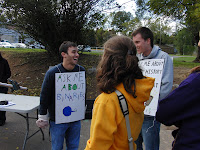
Emil Christensen illuminated on the history of astronomy, geo- vs helio-centric systems, telescopes, distances to stars, etc…

Anca Constantin featured the big bang and the history of the universe:

You can see here many more pictures with us and the curious people who surrounded us on that first day of October (also our 1st, and thus our debut with the "Astronomy at the Market" Show).
Thursday, September 29, 2011
Our first thin film obtained with the ALD reactor
Today marks the first successful thin film growth of Titanium Dioxide on Silicon substrate with the new ALD reactor built last summer in Dr. Costel Constantin's lab. This will enable us to grow oxide nanolayers or nanowires on semiconducting surfaces that can be used in building more efficient field effect transistors. A crucial role in this success were the efforts of Matthew Chamberlin, Kristen Deganais (REU student from University of Maryland Baltimore County), Bojan Ljubovic, and Renee Ahern who joined our group at the beginning of this semester. Renee helped a lot with setting up the ALD reactor for several growth attempts preceding today's growth.
... More on radiative polaritons at JMU!

On October 19-22 2011 the 78th Annual Meeting of the Southeastern Section of the APS will take place at Virginia Tech. At the event, Anita Vincent-Johnson, undergraduate student in Physics at JMU, will present the results of the study she performed this summer under the guidance of Dr. Giovanna Scarel and in collaboration with Dr. James Hammonds of Howard University in Washington DC. The study investigated computationally and experimentally the dispersion relations of radiative polaritons in thin oxide films. The team was finally able to demonstrate the radiative nature of the polaritons excited in thin oxide films by infrared radiation. These results will have great impact on the ongoing effort of the team to exploit radiative polaritons for harvesting energy from infrared radiation.
Monday, September 26, 2011
Radiative polaritons at JMU!

Today Applied Physics Letter has published a paper reporting the discoveries made by a group of researchers at JMU. The paper is entitled “Heat recovery mechanism in the excitation of radiative polaritons by broadband infrared radiation in thin oxide films”. Anita Vincent-Johnson and John Bridstrup, undergraduate students in Physics, and Kyle Vasquez, who graduated in Chemistry last Spring, worked on the project between Summer 2010 and Summer 2011. Andrew Masters of Custom Thermoelectric (Bishopville - MD) developed the devices. Harry Hu contributed in improving the set up for the measurements. Giovanna Scarel led the team. The hope of the authors is that this research would trigger new work in buildig cells capable to harvest infrared radiation and convert it into electricity. Since infrared radiation is available day and night, the cells should work without interruption.
Saturday, September 24, 2011
Superluminal Neutrinos

Fall Picnic

See the full set of photos here.
Friday, September 23, 2011
JMU in the ALD firmament

On September 20 2011 the Journal of Vacuum Science and Technology A published the paper “Wetting properties induced in nano-composite POSS-MA polymer films by atomic layer deposited oxides”. The paper reports the work performed by the JMU students Kyle Vasquez and Anita Vincent-Johnson under the guidance of the JMU faculty Chris Hughes, Brian Augustine, and Giovanna Scarel. The JMU team worked in close collaboration with the partners at NCSU: Kyoungmi Lee and Gregory Parsons. This paper will be included in a special issue of JVSTA totally devoted to Atomic Layer Deposition and will introduce JMU in the ALD firmament!
Thursday, September 22, 2011
Could relativity be wrong?

From LiveScience
Physicists have found that tiny particles called neutrinos are making a 454-mile (730-kilometer) underground trip faster than they should — more quickly, in fact, than light could do. If the results are confirmed, they could throw much of modern physics into upheaval.
If this is verified, hang on to your hat. The ride will be wild. Overturning the universal speed limit changes everything.
I suggest not betting heavily on this being true.
Saturday, September 17, 2011
Do basketball like a theoretical physicist

Just in case you thought that theoretical physicists were only occupied with quarks, big bangs, phase changes, and Bose-Einstein condensates...think again. Alan Gabel and S. Redner at the Center for Polymer Studies and Department of Physics, Boston University have made an excellent examination of scoring in basketball. The abstract spells it out:
Now you can tell your friends you were studying physics the next time you watch an NBA game on TV.We present evidence, based on play-by-play data from all 6087 games from the 2006/07–2009/10 seasons of the National Basketball Association (NBA), that basketball scoring is well described by a weakly-biased continuous-time random walk. The time between successive scoring events follows an exponential distribution, with little memory between different scoring intervals. Using this random- walk picture that is augmented by features idiosyncratic to basketball, we account for a wide variety of statistical properties of scoring, such as the distribution of the score difference between opponents and the fraction of game time that one team is in the lead. By further including the heterogeneity of team strengths, we build a computational model that accounts for essentially all statistical features of game scoring data and season win/loss records of each team.
Friday, September 16, 2011
Department Picnic
The annual Fall PandA picnic is Sunday September 18th at 1:00 PM. As usual, we will be in Purcel Park.
Come join us for the fun.
Come join us for the fun.
Thursday, September 15, 2011
Matt's first paper has been accepted!
Matthew Chamberlin who worked (really HARD!) with Prof. Costel Constantin since 2010 will publish his first paper in the Material Research Society Symposium Proceedings Journal.
The paper is entitled “Zinc and Zinc Oxide Nanowires Grown on PEDOT:PSS/SiO2 Conductive Polymer Thin Films by Vapor Phase Transport Deposition” and a copy of the paper can be found here. Matt is very intrigued by neuroscience, and I hope this paper will encourage him to apply to graduate schools where he can pursue his dream.
Congratulations!
Tuesday, September 13, 2011
How is Science Done?
We live in extraordinary times. We know that our Universe began with a Big Bang 13.76 billion years ago, plus or minus 0.11 billion years (~1% precision!). We have learned that we really don't know what ~96% of the Universe is made of (i.e., "dark matter" and "dark energy"). We have very strong observational evidence that not only does our own Milky Way Galaxy harbor a supermassive black hole, but that every galaxy has one. Big puzzles remain as to how they grow to their large masses, and why some black holes are active and some are dormant. These scientific results are all a consequence of the scientific method, exemplify how progress is made and our knowledge advanced.
But do all members of our society and media truly understand how science is done and its importance? Indeed, in the last blog entry, we talked about a Physics department in trouble at UNC-W and the need for more physicists. In an intriguing article published online today and making its way around the internet, an astronomer who was part of the team that recently found evidence for a "diamond planet" calls into question whether our society truly understands how science is done and the consequences it has for us. If you have not already read it, I encourage you to do so. You can find the article here.
Saturday, September 10, 2011
A Physics Department in Trouble
The University of North Carolina-Wilmington has announced its plan for dealing with the 15.8% budget cut imposed on it by the state of North Carolina. Part of this is to merge the Department of Physics and Physical Oceanography with the department of Geology and Geography to form one department. This will, according to the administration result in the saving of about $80,000/year due to the reduction of one administrator and one staff position.
There is a petition seeking to reverse this decision and you are urged to visit and read what others have said and express your opinion.
We need more rather than less physics in the world. Add you voice to those who are trying to preserve this educational opportunity for the UNC-W students.
There is a petition seeking to reverse this decision and you are urged to visit and read what others have said and express your opinion.
We need more rather than less physics in the world. Add you voice to those who are trying to preserve this educational opportunity for the UNC-W students.
Friday, September 02, 2011
What Students Think...
With the start of the new semester, students return to the classroom eager and excited to learn! Well, ok maybe not everyone. Nevertheless, students do walk into our classroom with preconceived notions about how the world works, some of which are just wrong. A classic example is the cause of the seasons, where in survey after survey, a majority of respondents claim the cause of our seasons is the changing Sun-Earth distance (not right!). Curious to learn what my students think when they hear the word "Astronomy", I asked my Astronomy 120 (The Solar System) students to write three words on an index card. The wordle below is the result of this exercise.

Saturday, August 27, 2011
PandA Photo

Standing, left to right:
Anca Constantin, Deepshikha Shukla, Kevin Giovanetti, Costel Contantin, Gabriel Niculescu, Art Fovargue, Shanil Virani, Shaleen Shukla, Chris Hughes, Mark Mattson, Giovanna Scarel, Harry Hu and Steve Whisnant.
Seated, left to right:
Sean Scully, Ioana Niculescu, Harold Butner, Brian Utter, Scott Paulson, Klebert Feitosa, Adriana Banu, Geary Albright and Kim Emerson.
Not present:
Don Chodrow and Elizabeth Jeffery.
We have an amazing and diverse faculty. Our size is impressive, comparable even to some PhD granting institutions. We are up to 21 full-time faculty now.
Thursday, August 25, 2011
Nanoparticles and atomic layer deposition
A team of researcher from NCSU and JMU has discovered a method to fabricate FePt nanoparticles using atomic layer deposited Al2O3! The paper is published online by Nanoscale: A.C. Johnston-Peck, G. Scarel, J. Wang, G.N. Parsons, and J.B. Tracy, “Sinter-free phase conversion and scanning transmission electron microscopy of FePt nanoparticle monolayers”. G. Scarel - JMU - has deposited the Al2O3 layers.
For us, its tomorrow...
While students are flocking in (except for freshmen, who are already here) this weekend for classes to start on Monday, for the faculty, it begins tomorrow. We have a day filled with the joy of meetings: all faculty in the university followed by a college meeting and finally one for the department.
On the other hand, we do get fed twice, once by the university and once by the college. But by the department meeting we're all full and just ready to go home. Thus, it starts with a meeting of mostly announcements and is over pretty quickly. There will be another department photo this year, so watch for this next on the blog.
So, all you students and former students, just realize that the work starts sooner for us (and in May lasts longer). While you are out having the last party before classes this weekend, we'rehaving a last fling as well home making final preparations for class and getting our syllabi and notes in order.
Welcome back. See you on Monday.
On the other hand, we do get fed twice, once by the university and once by the college. But by the department meeting we're all full and just ready to go home. Thus, it starts with a meeting of mostly announcements and is over pretty quickly. There will be another department photo this year, so watch for this next on the blog.
So, all you students and former students, just realize that the work starts sooner for us (and in May lasts longer). While you are out having the last party before classes this weekend, we're
Welcome back. See you on Monday.
Friday, August 12, 2011
Subscribe to:
Posts (Atom)