Tuesday, January 24, 2012

Conference for Undergraduate Women in Physics


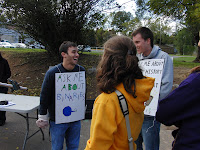
Renee Ahern, Christina Hanks, Anita Vincent-Johnson, Liz Visosky, and Nora Swisher attended the Southeast Conference for Undergraduate Women in Physics (SCUWP) at the University of Tennessee, January 12-15, 2012.  Here's what Nora says about the experience.                   

Over the long weekend we got to attend talks from successful women in physics, present our own research, interact with other women in physics over free meals, and listen to panels discussing careers, grad school, and undergraduate research.  We also got to tour Oak Ridge National Laboratory and see some of the incredible resources there, like the Spallation Neutron Source and their supercomputing facility. This is actually the 2nd year I’ve attended this conference (Anita and I went to it at Duke University in 2010). I thought both trips were great experiences. SCUWP and other women in physics events provide the opportunity for young women to network and gain motivation and support to continue physics.

It is not O.K. that there are so few women in physics in the United States. Because of societal cues given to us our whole lives, women tend to have more self-doubt in their STEM abilities, and people have internal bias against women in STEM fields whether they realize it or not (women need to higher credentials in order to be judged as equally productive as men). To fix this we need the current women in physics to stay and continue breaking the mold. We need role models and mentors for young women, and we need to keep improving the climate by continuing to have good family policies, flexible schedules, and speaking out when colleagues make inappropriate comments. As an anecdote, I have experienced some inappropriate conversations, although the men probably did not realize it was uncomfortable for me. Once during a class, the professor and students discussed a system to rate female physical attractiveness. That might not have happened in class with a different female student ratio.
Although, women have some equalities (equal pay not being one of them), women still have many stereotypes to overcome. Unfortunately some of these stereotypes are preventing physics from gaining all the contributions that women and other minorities have to offer. I know it’s a subtle and difficult problem to fix, but it should be fixed before we can call our society truly equal, developed, and rational. 

Wednesday, January 18, 2012

New Planetarium Shows, Public Star Parties and the End of the World!?


With the start of a new semester already in full swing, there is a lot going on that John C. Wells Planetarium this semester! This month the 2:30pm family show is "Legends of the Sky: Orion", while the the 3:30pm feature show is "Stars of the Pharaohs". Following each show, a live star talk featuring the Harrisonburg night sky will be presented. Both shows are FREE with seats available on a first-come, first-seated basis! You can find our full schedule of shows that will be presented this semester at the Planetarium website.

A brand new initiative we are launching this semester is monthly star parties at Astronomy Park, located in the meadow behind the Physics & Chemistry building. The first star party will take place on Friday, January 27 starting at 7pm with subsequent public observing sessions on the last Friday of each month! Since these observing sessions are weather-dependent, the decision to proceed with observing or to postpone to Saturday (our back-up night) will be made by 4pm on each day. This decision will be published on the Planetarium website, the Planetarium facebook page and via the Planetarium twitter feed. If you have never seen Jupiter with its Galilean satellites, Saturn and its majestic rings, Mars, Venus or even the Moon through a telescope, you definitely do NOT want to miss any of these star parties!


Lastly, with calendar turning the page to 2012, no doubt you have heard of the many ridiculous doomsday scenarios circulating online and in the tabloids you see at the grocery store. All these end-of-the-world prophecies, from the Mayan calendar ending, to the Earth's magnetic field suddenly reversing polarity in 2012, are all baseless and without any scientific merit. I've written my own short "Debunking 2012 Doomsday Prophecies" which you can find at the Planetarium website.

I hope to see many of you at the Planetarium or at a star party this semester!
Clear skies!

Shanil Virani
Director, John C. Wells Planetarium


Wednesday, January 11, 2012

Hard Times for Physics Departments Everywhere

In the APS News ,December 2011 (Volume 20, Number 11) the Back PageThe Economics of Education: Closing Undergraduate Physics Programs, by Theodore Hodapp describes a pretty dismal state of affairs for physics Departments in this country. The heart of the matter is given in this paragraph:

These recent decisions in a number of states indicate that the era, if it ever existed, of a program existing because it is unthinkable not to offer physics is over. Dominating the current academic landscape are huge numbers of business, psychology, communications, and life-sciences majors. Physics undergraduate degrees accounted for 0.88%2 of all majors in 1966. Now they account for 0.32%. Figure 1 shows how physics has fared compared to the aggregate STEM (Science, Technology, Engineering and Mathematics) fields. The total number of physics graduates is roughly the same as it was in the late 60’s at around 6,000, but as a fraction of the undergraduate degrees it has fallen by almost a factor of three from its former standing. Further, if you normalize the data to the US population, which increases at roughly 1% per year, the data indicate that other majors have successfully lured away students who previously would have majored in physics. As a colleague recently said to me, “Who is better equipped to deal with the challenging problems that currently face our society–physics or psychology majors?” Psychology graduates increased from roughly 17,000 to 100,000 in those same four and half decades.

All pretty sobering stuff. Have a look at the full article for all the details.

Wednesday, January 04, 2012

Grant awarded for research on radiative polaritons


The Jeffress Memorial Trust has awarded a grant in support to the research that Dr. Scarel and her students are pursuing to understand the interaction between infrared radiation and matter. The funding will support an experiment in which infrared radiation with electric field perpendicular to the surface of a planar oxide film will excite radiative polaritons. A linearly polarized electromagnetic field, such as that used in the proposed experiment, is shown in the picture above. This experiment is expected to unambiguously correlate the absorption of infrared radiation with radiative polaritons. Dr. Scarel and her students hope that in the future the results of this research will inspire the design and development of devices to harvest and transform into electricity the infrared radiation from the sun and the atmosphere.

Jeffress Research grant awarded to Dr. Adriana Banu

Nuclear astrophysics research program at JMU is up for a good start in 2012!

The Thomas F. Jeffress and Kate Miller Jeffress Memorial Trust has approved a Jeffress Research grant of $25,000 to James Madison University in aid of Dr. Banu's project - "Studying the (alpha,p)-process in X-ray bursts using rare isotope ion beams". Dr. Banu and one of her research students, Brent Glassman, will conduct the research experiment, in collaboration with a team of scientists at the Cyclotron Institute at Texas A&M University, most probably in late spring this year. Stay tuned for the results! For more information, contact Dr. Banu at banula@jmu.edu.

Friday, December 23, 2011

Shanil Virani, Planetarium & Recruiting Director


The Department of Physics and Astronomy is delighted to announce that Shanil Virani will begin his duties full-time as Director of the John C. Wells Planetarium in January 2012. He brings planetarium experience both from Yale University as well as JMU. He is an enthusiastic and capable educator and is already working to move the planetarium program forward.

With our annual planetarium attendance near 10,000, there is already a vibrant program in place. Shanil already has many ideas for extending the reach of our programs both on- and off-campus. If you would like to discuss ideas for how the planetarium as a full-dome video facility, a star projection facility or as a unique auditorium can fit with your educational plans, please contact Shanil at viranisn@jmu.edu.

The Wells Planetarium is an amazing venue with capabilities unique among planetariums of its size. Come join Shanil in exploring the universe with the greater JMU community.


In addition to Shanil's duties in the planetarium, he is also charged with student recruiting. As many know, Dr. Jon Staib continues to orchestrate our winter recruiting/scholarship efforts that have done so much to grow our department into a nationally recognized program. However, since he retired several years ago, we've been living on borrowed time, hiring him part-time to continue with his successful approach.


This spring, Jon and Shanil will work together on the recruiting to pass the baton on to Shanil for the future. This combination of outreach and recruiting put Shanil in a central position to take our department to the next level in our quest to be the biggest, best and most amazing undergraduate physics department in the nation.


Join us in welcoming Shanil to his new position.

PandA Holiday Party


On the last day of classes, December 9, we hosted our annual department holiday party. As can be seen above, the pizza was a welcome component of the festivities.


Santa's helper, Dr. Butner, delivered a welcome round of joy and presents. The students also roasted presented gifts for the faculty.

A complete set of photos is found here.

As always the holiday video was met with howls of laughter and a good time was had by all.

Friday, November 18, 2011

Mystery of the Christmas Star


The John C. Wells Planetarium at JMU and the JMU Department of Physics and Astronomy are pleased to present a special full-dome planetarium movie entitled "Mystery of the Christmas Star" beginning THIS FRIDAY & SATURDAY evenings at 7pm! This movie allows audiences to journey back 2000 years to Bethlehem in pursuit of a scientific explanation of the star the wise men followed to find the baby Jesus. This modern retelling of the Christmas story is sure to charm and captivate audiences of all ages. All shows are free and seats are first-come, first-seated! Each performance will be followed by a live star talk featuring the Harrisonburg night sky.

The John C. Wells Planetarium is located in Room 1103 of Miller Hall.

Monday, November 07, 2011

Astronomy at the Market II

If you missed Team Awestronomy at Harrisonburg's Farmers Market last Saturday... you missed another good show (wondering about our debut? it's been immortalized here)! The team had a rain (snow) check appearance for the event scheduled for October 29th, when the weather was just impossible for any solar view or relaxing conversations about the Sun, Galaxies, Binary Stars, Big Bang, the History of Astronomy, you name it, only it has to be astro-wise...

On November 5th, the day was gloriously sunny, and the expected (and existing) cold temperatures did not seem to bother anybody eager to watch the Sun in action and understand its whereabouts. And it paid off: there were three quite obvious flares a the edge of the solar circle, and two other little bunches (sunspots come in pairs, usually) smack in the middle, very clearly spotted with the ... sunspotter.

Witness the team in action:


Do you know why the team was there last Saturday, and will be there again next semester (planned for every last Saturday of the month, weather permitting)? Read this, they confessed:

Emil Christensen: The reason I wake up at eight AM on some of my Saturdays is for science. It may sound corny, but it is true nonetheless. I have a lot of fun with the team taking astronomy to the market. There is a great sense of camaraderie in our group, and it makes it that more of an enjoyable experience. Also, it gives me a chance to share what I know, and hey, who would't want to play with liquid nitrogen.


Anthony Saikin: My reasons for doing this:
-Its not everyday that you see a group of people out with a telescope, It truly sets a person's day apart from others.
-The public usually isn't that Astro-literate. It's nice to educate the public.
-The conversations wi
th people. Those who stop by often are interested in what we are doing there and sometimes the conversation will stray from Astronomy into some local science education issue, and how more opportunities for science education should be available.
-Its fun. Especially making Edible Comets, and serving them to people.


Jimmy Corcoran: I enjoy bringing Astronomy to the Farmer's Market because it's a great way to share and spread scientific knowledge within the Harrisonburg area. It surprises me everytime how many people, of every age, show their interest in science when given the opportunity.


Nathan DiDomenico: Science’s positive effects on society are numerous and sizeable. Along with other parts of our culture such as politics and fine art, science has sculpted our civilization into what it is today. Artists and politicians often have large groups of fans that they rely on for success , but the public seems removed from the process scientific discovery and therefore many feel apathetic towards the field of science. This cannot be allowed because progress in the scientific pursuits also relies heavily on how many fans it has. You don’t have to be a scientist to be a fan of science; you only need to recognize the benefits and beauty of scientific curiosity and discovery. The reason I am happy to bring astronomy to the market is because astronomy is a very astounding and wonderful field in science and I think that by talking about it with people I can play a small role in creating more fans of science.


Kyle Eskridge: Astronomy at the market is a good opportunity to get the community excited about astronomy and science in general. It is particularly good to get children excited about science because it may inspire them to one day become scientists or engineers which we could always use more of.

Thanks everyone for the smart questions and comments on how science fills up your everyday lives!


Tuesday, October 25, 2011

Support Don Chodrow

The Department of Physics and Astronomy is nominating Dr. Chodrow for the College of Science and Mathematics Teaching Award. Please send an e-mail to Dr. Scully (scullyst@jmu.edu) telling why you think Dr. Chodrow deserves this award. How did having him for mechanics (or other courses) change your life, your career path, your understanding of physics? Time is short. Get your e-mail to Dr. Scully by November 1.


This is your chance to thank him for that mental kick he gave you to start you on the path to success. Help us help him get the recognition he deserves.

Tuesday, October 04, 2011

3 Astronomers Share the 2011 Nobel Prize in Physics!

This morning 3 American astronomers received the call of a lifetime when they were notified by the Nobel committee that they would share the 2011 Nobel Prize in Physics!

Prof. Adam Riess of The John Hopkins University/Space Telescope Science Institute, Prof. Saul Perlmutter of the Lawrence Berkeley National Laboratory/UC Berkeley and Prof. Brian Schmidt, an American now working at the Australian National University, were recognized “for the discovery of the accelerating expansion of the universe through observations of distant supernovae.”

In the 1920s, Edwin Hubble discovered that the Universe is expanding. He found that the further a galaxy is from us, the faster it moves away. If you play this movie backwards, it provides an independent piece of evidence that there was a Big Bang. Today, these 3 astronomers are being recognized for their 1998 discovery that the expansion of the universe is actually accelerating and not linear like Hubble discovered. This accelerating expansion is being driven by a mysterious force called "Dark Energy" about which little is known except that it makes up ~70% of the Universe! The group that discovers what Dark Energy actually is will likely also win the Nobel Prize in Physics.

That these 3 astronomers won the Nobel Prize for their work is not surprising since it was recognized immediately after publication that their result has a profound significance on our understanding regarding the evolution of our Universe. Indeed, both teams shared the 2007 Peter Gruber Foundation Cosmology Prize -- a gold medal and $500,000 -- and Science magazine dubbed their work as "The Breakthrough Discovery of the Year" in 1998.

Congratulations gentlemen on a very well-deserved honor!

Sunday, October 02, 2011

We took the Astronomy at the Market, literally.

One astro faculty and a group of astro students (you'll see exactly which ones soon) took the department's Coronado solar telescope at the Harrisonburg Farmers Market. Along with the telescope, they also sported asunspotter, also to catch the Sun of course, just a little bit differently, in a clearly safe and simple way. The group also "cooked" edible comets (tasting suspiciously like ice cream), and showed how they can form their tails when the future eater pretends to be the Sun and blows a bit of "solar" wind on them.

The kids enjoyed probing cratering on potential planets' surfaces with a variety of impactors (i.e., peebles). Imagine all these while we all talked a lot about astronomy:

The black holes were surely a hit, mainly because Nathan DiDomenico was there to answer the questions:


Kyle Eskridge mastered the Sun:


Jimmy Corcoran went extragalactic:

Anthony Saikin delighted audience with details about binary stars:


Emil Christensen illuminated on the history of astronomy, geo- vs helio-centric systems, telescopes, distances to stars, etc…


Anca Constantin featured the big bang and the history of the universe:


You can see here many more pictures with us and the curious people who surrounded us on that first day of October (also our 1st, and thus our debut with the "Astronomy at the Market" Show).

Thursday, September 29, 2011

Our first thin film obtained with the ALD reactor

Today marks the first successful thin film growth of Titanium Dioxide on Silicon substrate with the new ALD reactor built last summer in Dr. Costel Constantin's lab. This will enable us to grow oxide nanolayers or nanowires on semiconducting surfaces that can be used in building more efficient field effect transistors. A crucial role in this success were the efforts of Matthew Chamberlin, Kristen Deganais (REU student from University of Maryland Baltimore County), Bojan Ljubovic, and Renee Ahern who joined our group at the beginning of this semester. Renee helped a lot with setting up the ALD reactor for several growth attempts preceding today's growth.

... More on radiative polaritons at JMU!


On October 19-22 2011 the 78th Annual Meeting of the Southeastern Section of the APS will take place at Virginia Tech. At the event, Anita Vincent-Johnson, undergraduate student in Physics at JMU, will present the results of the study she performed this summer under the guidance of Dr. Giovanna Scarel and in collaboration with Dr. James Hammonds of Howard University in Washington DC. The study investigated computationally and experimentally the dispersion relations of radiative polaritons in thin oxide films. The team was finally able to demonstrate the radiative nature of the polaritons excited in thin oxide films by infrared radiation. These results will have great impact on the ongoing effort of the team to exploit radiative polaritons for harvesting energy from infrared radiation.

Monday, September 26, 2011

Radiative polaritons at JMU!


Today Applied Physics Letter has published a paper reporting the discoveries made by a group of researchers at JMU. The paper is entitled “Heat recovery mechanism in the excitation of radiative polaritons by broadband infrared radiation in thin oxide films”. Anita Vincent-Johnson and John Bridstrup, undergraduate students in Physics, and Kyle Vasquez, who graduated in Chemistry last Spring, worked on the project between Summer 2010 and Summer 2011. Andrew Masters of Custom Thermoelectric (Bishopville - MD) developed the devices. Harry Hu contributed in improving the set up for the measurements. Giovanna Scarel led the team. The hope of the authors is that this research would trigger new work in buildig cells capable to harvest infrared radiation and convert it into electricity. Since infrared radiation is available day and night, the cells should work without interruption.

Saturday, September 24, 2011

Superluminal Neutrinos

The paper reporting on the faster than light neutrinos observed at CERN is on the web. It is clear that is not a simple time-of-flight measurement. It is also clear that a tremendous amount of work went into measuring the times and determining the distance.


Fall Picnic


To start off the semester we enjoyed our annual fall picnic on Sunday afternoon September 18. We met at Purcel Park to enjoy the culinary delights grilled up by Costel Constantin. There was much good food brought and soccer for the ambitious.

See the full set of photos here.

Friday, September 23, 2011

JMU in the ALD firmament


On September 20 2011 the Journal of Vacuum Science and Technology A published the paper “Wetting properties induced in nano-composite POSS-MA polymer films by atomic layer deposited oxides”. The paper reports the work performed by the JMU students Kyle Vasquez and Anita Vincent-Johnson under the guidance of the JMU faculty Chris Hughes, Brian Augustine, and Giovanna Scarel. The JMU team worked in close collaboration with the partners at NCSU: Kyoungmi Lee and Gregory Parsons. This paper will be included in a special issue of JVSTA totally devoted to Atomic Layer Deposition and will introduce JMU in the ALD firmament!

Thursday, September 22, 2011

Could relativity be wrong?


From LiveScience
Physicists have found that tiny particles called neutrinos are making a 454-mile (730-kilometer) underground trip faster than they should — more quickly, in fact, than light could do. If the results are confirmed, they could throw much of modern physics into upheaval.

If this is verified, hang on to your hat. The ride will be wild. Overturning the universal speed limit changes everything.

I suggest not betting heavily on this being true.

Saturday, September 17, 2011

Do basketball like a theoretical physicist


Just in case you thought that theoretical physicists were only occupied with quarks, big bangs, phase changes, and Bose-Einstein condensates...think again. Alan Gabel and S. Redner at the Center for Polymer Studies and Department of Physics, Boston University have made an excellent examination of scoring in basketball. The abstract spells it out:
We present evidence, based on play-by-play data from all 6087 games from the 2006/07–2009/10 seasons of the National Basketball Association (NBA), that basketball scoring is well described by a weakly-biased continuous-time random walk. The time between successive scoring events follows an exponential distribution, with little memory between different scoring intervals. Using this random- walk picture that is augmented by features idiosyncratic to basketball, we account for a wide variety of statistical properties of scoring, such as the distribution of the score difference between opponents and the fraction of game time that one team is in the lead. By further including the heterogeneity of team strengths, we build a computational model that accounts for essentially all statistical features of game scoring data and season win/loss records of each team.
Now you can tell your friends you were studying physics the next time you watch an NBA game on TV.