Sunday, March 27, 2016

2016 Physics Undergraduate Symposium

On Saturday, March 26th, the undergraduates of JMU Physics presented their research in front of their professors and colleagues.  Listed are those who presented, their research professor, and what topic they presented on.

Angelica Watson
Dr. Adriana Banu
Studying the (α,p)-process in X-ray bursts using rare isotope beams


Evan Meekins
Dr. Derek Dolney & Dr. Adriana Banu
Fitting the Bragg Curve: Increasing the Accuracy of Proton Therapy with On-Site Data Analysis


Brian Seymour
Dr. Klebert Feitosa
Interfacial Bubble Deformations


Jason Ferguson
Dr. Anca Constantin
Searching for Accreting Supermassive Black Holes in Bulgeless Galaxies


Jacob Green
Dr. Anca Constantin
Exploring Long-Term Variability in Active Galactic Nuclei Via Monte Carlo Simulations of Optical Spectra


David H. Olson
Dr. Costel Constantin
Structural and Electrical Characterization of Amorphous and Crystalline Manganese Oxide Thin Films Deposited by DC Magnetron Sputtering


Justin M. Kaczar
Dr. Giovanna Scarel & Dr. Brian Utter
Effect of Angle Dependence on the Electric and Entropic Contributions of Infrared Power Generation


Thomas St. John
Dr. Giovanna Scarel
The effects of infrared radiation power variation on infrared power generation


Griffin Hundley
Dr. Sean Scully
Searching for Traces of Planck-Scale Physics with High Energy Gamma Rays


Justin Leas
Dr. Keigo Fukumura
X-ray Photoionization of Magnetically-Driven Accretion-Disk Winds


Olivia Cypull
Dr. Klebert Feitosa
Droplet Dynamics of a Flowing Emulsion System


Ian Davenport
Dr. Ilarion Melnikov
Classification of Landau-Ginzburg Theories

Josiah Lapolla
Dr. Dana Longcope & Dr. John Unverferth
Modeling the Effects of Magnetic Field Variation on Solar Flares


Sean Scro
Dr. Keigo Fukumura
Spectroscopic Modeling of X-ray Absorbers in the Transient Black Hole Binary GRO J1655-40


Aidan Gordon
Dr. Giovanna Scarel & Dr. Brian Utter
Modeling Chaotic Phenomena


Many thanks to everyone who presented!

Gliding Through the Last Demystifying the Expert

Last Thursday (March 24th), Dr. Anca Constantin and Dr. Klebert Feitosa hosted New & Improv'd and Dr. Roshna Wunderlich for the last "Demystifying the Expert" of the 2015-2016 school-year.


The evening started off well with a 20 questions-esque game where the improv team had to guess Dr. Wunderlich's professional title and research topic.  Several guesses included, but were not limited to, "Can it be found in Disney World?  In the hearts and minds of children?", "Is it us?  A young body like mine?  Inside us?!", and "Is it that thing Dr. Frankenstein used to bring his monster back to life?" 

After a series of laughs, the audience learned that Dr. Wunderlich is a professor in Biology and head of the JMU Women's Rugby Team.  She also researches the behavioral patterns of societal interactions of lemurs.  She does so in the prospect of learning the secrets of their longevity, and perhaps apply that knowledge to expanding the human lifespan.  Many think that their heightened lifespan has to do with the fact that they hibernate for seven months, which could also help humans in the field of space travel in regards to cryostasis.


When asked how they endure this, Dr. Wunderlich explained that they store the food as fat in their tail, which warranted a "junk in the trunk" reference and possible qualifications for future astronaut candidates.  Dr. Wunderlich then talked about how her team tracks the lemurs with fitbits and magnetic field positioning techniques, as well as their interactions with their children.  She also described the lemur mating season as "like Spring Break in Tampa," with the improv group adding, "That must be the craziest three days ever!"

Further discussing lemurs, the improv teamed asked how they lemurs respond when Dr. Wunderlich's team interacts with them.  She answered, "We just blowdarted them out of a tree, how do you think they feel?"  When asked if she hunted them, Dr. Wunderlich responded, "No we have a guy who's really good with a blow dart.  We just catch them when they fall."

The event concluded with the improv group guessing several biological acronyms/terms, as well as the 2-truths & 1-dare game.  This led to great discussions about how mother lemurs jump from tree to tree with their babies attached to them, healthcare costs for the average lemur, and the differences between Rugby and common terminologies.

Thank you to everyone involved in the last Demystifying the Expert of the year!


Friday, February 19, 2016

Rocking the House and Demystifying the Expert


This past Thursday, Dr. Anca Constantin and Dr. Feitosa hosted the 5th JMU Demystifying the Expert.  They were joined by Geology professor Dr. Steve Whitmeyer, and JMU's comedy troupe "New & Improv'd".

For those unfamiliar with Demystifying the Expert, the routine focuses on explaining scientific ideas through comedic games and trivia.  Usually each entry focuses on a single faculty member, and what kind of research they do.

After proper introductions, the night opened up with a 20-questions style game, where New & Improv'd asked Dr. Whitmeyer yes or no questions regarding his field of study.  Knowing that he focuses on some form of geology, the comedians asked "relevant" questions ranging "Do you work with earthquakes?" to "How precious are your stones?"  The comedy rolled in loud and fast, and the audience loved it.


With the audience's full attention, Dr. Whitmeyer explained that he studies plate tectonics and the effects they have had on not only our terrain, but also on how we adapted our societies to said terrain.  He then used the example of JMU's own Bioscience building, which was to be built on caves that needed to be filled in before construction.  This prompted the comedians to ask what "JMU was trying to cover up" down there, with the panel agreeing that Jimmy Hoffa is most likely down there.

Our hosts then shifted the topic to various headlines relating to Geology, such as Pakistani islands eroding away, earthquakes throughout Oklahoma, the return of the Grand Canyon rapids, and the effects of fracking on earthquake systems.  This lead to discussions about the "living" nature of the Earth, how quickly islands can form and be eroded away, and the plausibility of Christopher Walken's devious plot in "James Bond 007: A View to Kill."


In the next game, the comedians were challenged to decipher different Geological terms, acronyms, and shortenings.  While they were very proficient at knowing/guessing some of them, other terms like Pseudotachylite were apparently "abstract touching thing."  This discussion lead into the evolution of geological ideas, the new movement to crowd-source science to the masses for research, and the ability to take our knowledge of Earth's geology and apply it to other planets, such as Mars.

The evening was filled with science and laughs, and many thanks to all of the people who made it possible.

Be sure to check out the next Demystifying the Expert on March 24th! 

Friday, February 12, 2016

NASA Engineering Leader Jill Prince Comes to JMU

This past week, JMU was fortunate enough to host NASA Engineering Manager Jill Prince for a series of talks. 

Ms. Prince has a deep history in astronomical research, joining NASA Langley in 2001 and supporting the flight mechanics team for the years that led up to the Phoenix Mars landing in 2008.  Afterwards, she served in an array of NASA administration positions for many years, eventually leading her to be appointed to Manager of the System Engineering Office in 2015.  Ms. Prince has also been awarded a number of accolades, including the NASA Exceptional Achievement Medal and the Women in Aerospace Achievement Award.  She first spoke at Wilson Hall on Thursday to the general James Madison student body, and then again to the JMU Physics & Astronomy Department on Friday.

The NASA engineer opened up her talk discussing the prospects, goals, questions, history, and philosophy of NASA.  She then went into the more current Mars-based operations, such as MAVEN, the Mars Orbiter Mission, and the Curiosity Rover.  She also discussed future missions, such as perfecting the Trace Gas Orbiter and the ExoMars Rover.


Ms. Prince then went on to discuss how NASA plans to continuously study and eventually land advanced systems on Mars, starting with Earth-based systems and then slowly reaching farther towards the Red Planet with satellites and such.  The focus of these steps, Prince explained, is to make future missions to Mars self-sustaining Earth-independent, which involves mining asteroids and increased solar tech.  These processes also include fulling mapping the topography of Mars, cataloging the materials available at its surface, and understanding Martian weather patterns, such as dust storms.

Also displayed in her presentation were the rockets, Block 1 and Block 2, to be used on the eventual manned mission to Mars.  Block 1 is meant to transport people, while Block 2 is meant to transport the majority of the equipment to Mars.  She also discussed the sophisticated Orion spacecraft, which will be used to land the astronauts on Mars, and the various challenges it faces, most notably Mar’s thin atmosphere and rugged terrain.  Many of the other challenges she discussed involved protecting our astronauts, such as radiation poisoning and providing/creating enough fuel for the trip home.

Many thanks to Ms. Prince for taking a break from her astronomically important schedule to talk to us here at JMU!

Thursday, February 11, 2016

Another One Goes to Einstein: The Discovery of Gravitational Waves

Nearly a hundred years ago, Einstein put forth a theory that suggested the existence of gravitational waves, which alter space-time in massive astrophysical events.


According to the New York Times, such an astrophysical event (the collision of two black holes over a billion light years away) has been observed and is in agreement with Einstein's theory.  The wave function which resulted from this event was observed by both the LIGO facilities in Livingston, Louisiana and Hanford, Washington.  These reading were in agreement, giving great evidence that the theory could be a physical law.

Congratulations to the LIGO team and everyone involved in this groundbreaking observation!

Monday, February 01, 2016

That's no moon!


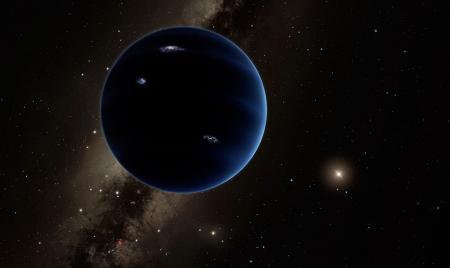
Word has spread around about a new object circling the Sun, and the discussion has begun about whether or not this "Planet Nine" is even a planet at all.


While NASA has said that the 'planet-ness' of Planet Nine is still a theory, many people are already speculating the object's composition, both atmospheric and mineral.  However, this has proven difficult due to the object's distance from the Sun and background radiation from the Milky Way.

What we do know about the object, as posted by Science Magazine, is that the object has around the mass of 10 Earths, it has an orbit of 15,000 years, and there's only a 0.007% chance that these observations are just coincidentally the six previously known objects that orbit around Neptune.

As more information surfaces, this is sure to be a thrilling debate and discovery in the astronomical community!

More importantly, how does Pluto feel about all of this?

Hear Planetarium Director, Shanil Virani's take on the discovery announcement of Planet Nine as part of his #OurIslandUniverse series on NPR!

JMU goes to CUWiP 2016!

On January 15th, Olivia Cypull, Devin Buennemeyer, Tara Jobin, Gillian Schuneman, and Yvonne Kinsella represented JMU at this year's Conference for Undergraduate Women in Physics.  The meeting was hosted by the APS, Old Dominion University, and Jefferson Lab in Norfolk, Virginia.  They were joined by over 200 other academic women


The conference is not only important in encouraging more women to participate in STEM fields, but to also open up great opportunities for those who attend.  These opportunities include, but are not limited to, meeting colleagues in similar academic field, discovering research opportunities outside of one's home university, and even learning about appealing graduate programs.  The conference also hosted a plethora of different workshops that focused on the different obstacles, opportunities, and communities for women in the sciences.


Olivia Cypull, pictured above, presented her research with Dr. Fietosa regarding the study of soft matter physics.  Among the 40 posters presented, Olivia's poster presentation was awarded as the best in show, and was praised for its conciseness, depth of information, and interesting topic material.

Congratulations to all of the women who presented and represented James Madison University STEM!

Tuesday, January 12, 2016

JMU's presence at the 227th American Astronomical Society Meeting


The Winter meeting of this year's American Astronomical Society (AAS), the 227th overall,  held last week in Kissimmee, Fl, witnessed the most significant JMU presence yet, featuring five members of our Physics and Astronomy Department:  two of our undergraduate students, Catherine Witherspoon and Jason Ferguson, along with Anca Constantin, Keigo Fukumura, and Sean Scully (faculty).

The winter AAS meetings are the largest gathering of american astronomers anywhere, and the AAS refers to it as the "superbowl of astronomy."  Besides multiple and parallel science sessions, as well as workshops and splinter meetings, at these meetings official AAS business happens, prizes are awarded, job interviews are held, textbooks and telescope equipment are presented and purchased, collaborations are forged, and some of the biggest announcements in astronomy are made.

Basically, the pulse of the Universe is taken, one talk or poster at a time.
Work presented by JMU affiliates and their collaborators include new results on:


1. Searching for signatures of black hole accretion in centers of
bulgeless galaxies using new data from the Large Binocular Telescope


2. Understanding the potential links between the water megamaser
activity and nuclear galactic obscuration using data from the
Wide-Field Infrared Survey Explorer


3. The nature of the ultraviolet and X-ray absorbers present around
supermassive black holes, via novel modeling of the global magnetic
fields originating from the black hole accretion disk 


4. The mid and far infrared luminosity density and the Gamma-ray
opacity of the universe


Catherine and Jason's work has been supported by the 4-VA Collaborative at James Madison University, University of Virginia/NRAO, and George Mason University.  

Catherine's thoughts on her first AAS meeting: one of the best parts of the meeting was the Annie Jump Cannon Award talk about the dynamics of planets, stars, and black holes in triple systems. The speaker made most of her work understandable even to the lowly undergraduate, which was nice because there were some talks where I barely understood more than a few sentences at a time. However, the presentations opened up my eyes to entirely new areas of astronomy that I didn’t know existed and the other astronomers were always willing to chat with me about their research as well as my own research. This AAS meeting was an amazing experience that I hope to have again in the future.

And here are Jason's: an inspirational experience. I had the chance to meet many important astrophysicists from all over the USA including from the NRAO and NASA. I learned about what has been discovered this past year by the astronomical community as well as what is in store for the future. I presented my own research at a poster session during the conference, and I was able to do invaluable networking with other conference goers. There was an undergraduate session where I acquired information about various graduate school programs and internship opportunities. I am so excited for my next AAS!


Saturday, January 09, 2016

Nuclear Science Summer School for Undergraduate Students at Michigan State University


Michigan State University will be hosting the 1st Nuclear Science Summer School (NS3) during the period of May 16-21, 2016!

NS3 is a summer school for undergraduate students that aims to introduce the participants to the field of nuclear science. NS3 will offer lectures and hands'on activities covering selected nuclear science topics and providing an overview of the field. The school activities will take place at the National Superconducting Cyclotron Laboratory (NSCL) and will include lectures by local and visiting researchers, nuclear physics labs, a tour of the facility, discussions with graduate students and faculty, and social events. 

Who can apply
NS3 invites applications from Physics Majors in US institutions. Prerequisites are Calculus, Introductory Physics I (Mechanics and Waves), Introductory Physics II (Electricity, Magnetism, Optics) and preferably Modern Physics. Students should be at their second or third year of study at the time of application. Preference will be given to students who have limited opportunity at their home institution to attend a Nuclear Physics Class or Nuclear Physics Lab class. Applications from women and students from underrepresented minorities are strongly encouraged. 

Cost
Participation in NS3 is funded by the National Science Foundation and NSCL. Local expenses (accommodation and meals) will be provided. In addition, participants will receive up to $500 (actual cost) towards their travel to and from MSU.


Application Deadline: February 15, 2016 

For more information please visit the NS3 website: http://nscl.msu.edu/researchers/NS3.html or contact the NS3 organizers at: ns3@nscl.msu.edu


Monday, December 28, 2015

New paper .......

On November 27, 2015 the World Journal of Condensed Matter Physics published a new article: "A.L. Gordon, Y. Schwab, B.N. Lang, G.P. Gearhart, T.R. Jobin, J.M. Kaczmar, Z.J. Marinelli, H.S. Mann, B.C. Utter, and G. Scarel, “Decoupling the electrical and entropic contributions to energy transfer from infrared radiation to a power generator”.  World J. Cond. Matter Phys. vol. 5, 301-318 (2015)".  Aidan Gordon, Tara. Jobin, Justin Kaczmar, and Zach Marinelli currently are undergraduate students at JMU.  Yosyp Schwab, Brian Lang, Graham Gearhart, and Harkirat Mann graduated in May 2015.  Aidan and Yosyp contributed to modeling.  Brian, Graham, Tara, Justin and Zach performed countless data analysis.  Harkirat, Brian and Zach played a key role in setting up the experiments ......   The figure below shows one of the most significant finding: when infrared radiation hits a thermoelectric device coverd with colored tape the open voltage produced by the device is twice that generated without tape!  Such effect is absent when the thermoelectric device is activated with energy transferred from a resistor through Joule heating.  This finding supports the claim in the title!

Wednesday, December 23, 2015

2015 Photo Gallery Review


Let us look back on 2015 by marking just a few of the moments that stood out to us.


JMU students at the 10th annual Conference for Undergraduate Women in Physics at Duke U.

As well as the APS conference in San Antonio, TX.

Planetarium Director Shanil Virani and a few of our students teaching Staunton kids rocket science!

The lounge gets a much needed and appreciated makeover.

JMU students at CAA at Drexel in sunny Philadelphia.

A proper "send-off" for our former lab manager Art Fovargue.

Congratulations to the Class of 2015!  You all made it!

The Niculescu team lighting things up at JLab.

Our faculty going into the new academic year.
We also welcome Jacob Brown and Dr. Melnikov to the team!


Our PR is simply electrifying!

The esteemed Dr. Mather comes by for a visit!


Thanks to the help of many, a new map is hung depicting where our students have been!

And finally, the 2015 Holiday Video!

Thanks to everyone for a great year and here's to an even better one in 2016!

Sunday, December 13, 2015

'Tis the Season: Faculty Awards

We are celebrating the end of the semester with two new acknowledgements of our faculty's hard work, vision, and talent: 

Image result for chris hughes jmu
 Prof. Chris Hughes has been selected to receive The State Council of Higher Education for Virginia (SCHEV) Outstanding Faculty Award (OFA), which is the Commonwealth's highest honor for faculty at Virginia's public and private colleges and universities. This is a terrific recognition of his work and a testimony to the excellent work in physics and the encouragement and support of his colleagues. 


JMU's College of Science and Math Distinguished Teacher Award, which was established in 1981 to honor one faculty member annually for exemplary teaching, goes this year to Prof. Scott Paulson.  Scott is also the Cluster 3 (The Natural World) Coordinator for the General Education program at JMU.


 Two much deserved recognitions.