Thursday, October 20, 2016

To Infinity And …. An Internship?


Forgive our lateness in announcing this: On Thursday September 8th at 7:05pm, the OSIRIS-REx Asteroid Sample Return Mission was successfully launched at Cape Canaveral. This rocket, as seen above, contains a spacecraft that will travel to an approximately 4 billion year old asteroid named Bennu. The objective of this mission is to search for life as well as clues to the early formation of our solar system. Pretty cool right? It gets even better; JMU’s very own Kenny Gordon worked on this system!

Through an internship with NASA Goddard, Kenny was able to work directly on the test images produced by the cameras that will be guiding the spacecraft to Bennu. Specifically, Kenny worked on image analysis using MATLAB programming. The OSIRIS-REx uses a Touch-And-Go Camera System (or TAGCAMS) to navigate to the asteroid, map the asteroid, and monitor the storage of the sample on it’s return trip home (back to Earth).

Kenny at the Kennedy Space Center in Cape Canaveral, Florida
to witness first-hand the launch of the OSIRIS-REx Asteroid Sample Return Mission


Kenny tested two types of images, dark images and light images. All of the images were taken in a thermal vacuum chamber, which is as close to outer space as we can get. The dark images images were also produced in an incredibly dark room, again to simulate space. The light images were taken with the lights on. Kenny’s job was to look for dark current noise in the dark images and distortion in the light images taken by the camera and guess what, he found some!

One might say that Kenny singlehandedly saved the OSIRIS-REx mission. Well, maybe not singlehandedly, but he was able to present his findings to his mentor and genuinely contribute to the success of the mission. All of this from a summer-long (10 weeks) internship.

If this sounds exciting to you, it is not too late to either start thinking about an internship yourself or encourage your nearest physics major to pursue one.   Talk to professors and start thinking about where you would like to intern for your next summer.  Who knows, maybe you will find something unexpected.


-from Travis White (JMU senior physics major)

Monday, October 17, 2016

The Supermoon with the Mighty JMUO(bservatory)

On Wednesday evening, October 12, The Astronomy 320 class took the first images through our new Celestron 14" CGE Pro telescope using an SBIG CCD Camera. What better object to look at than Earth's nearest neighbor: the Moon.


The picture was taken at around 7:30 in the evening and depicts the waxing gibbous phase of the Moon, heading towards full this (just past) weekend. The Moon is at its nearest approach in its orbit producing a "Supermoon" - the largest apparent size of a lunar disk as seen from Earth. The current supermoon is especially grand as the Moon has not been this close in its orbit during the full phase since 1946. The next three full moons will all be Supermoons allowing for some of the best viewing of this object in 70 years.

-from Sean Scully

Wednesday, October 12, 2016

The 2016 WINNER of the JMU High School Physics Teacher of the Year Award

Starting this fall semester of 2016, the Department of Physics and Astronomy has initiated the "JMU  High School Physics Teacher of the Year Award".

The faculty in the Department of Physics and Astronomy at JMU are grateful for the hard work and efforts of the many high school teachers who prepare their students to continue their studies in the physical sciences and sympathetic to the many sacrifices and challenges they face in their work as a secondary science teacher.

This award is our recognition of a different high school physics teacher each year who is nominated by their former students, currently enrolled at JMU in STEM majors. To be considered for the award, the nominee should be an individual who exhibits exceptional dedication to teaching physics and has an outstanding record of going above and beyond in providing education and guidance necessary for the success of the students.

 We are proud to announce that 
the 2016 recipient of the JMU High School Physics Teacher of the Year Award
 is

Mrs. Sonia Faletti
Science Teacher at Bishop Ireton High School, Alexandria, VA 
(Stanford University - B.S. & University of Virginia - M.A.)
Congratulations!!

The student who nominated Mrs. Faletti is Isabel Ledesma, currently an Engineering major at JMU. Here is Isabel in her own words describing the exceptional attributes of Mrs. Faletti:
"Mrs. Faletti never failed to make my day. She was always enthusiastic about learning, especially learning about physics and its many applications. Whenever a student struggled with understanding a concept, she really took the time to explain what the problem may be and guided the student to a complete understanding of the concept. Additionally, she was energized by the discoveries that each individual made in her class. She was excited to see the look on one's face when he or she finally understood the concept or when their minds were blown away. Her wit and her smile were truly contagious, as one could never leave her class saying that it was not fun. My favorite aspects of Mrs. Faletti's class was the many demonstrations she did and the weekly hands-on labs. These were what made physics concrete for me to see and apply to everyday life. Mrs. Faletti never failed to entertain and educate each student. She is a wonderful guide through the mysterious and intriguing world of physics." (Isabel Ledesma)

Mrs. Faletti will be visiting us at JMU on Tuesday, November 8th (Election Day) when she will get to meet with our faculty and students, see our facilities, and receive a gift in recognition of the award. Feel free to join us in welcoming Mrs. Faletti at JMU!
 

This fall, our debut season of this award program, we had an amazing response from students with 20 nominations submitted (13 physics majors, 6 engineering majors and 1 math major).  
To all students who took the time to put forward their nominations we send you a big THANK YOU! We truly appreciate you joining efforts in recognizing those high school teachers out there who have made a positive impact on your studies of physics and related fields!!

Sunday, October 09, 2016

Expert Entertainment: Chris Rose on frogs, amphibians, and us


As most of you already know, Demystifying the Expert is a program hosted by our own professors Anca Constantin and Klebert Feitosa that is meant to introduce the public to science by combining comedy and education. The event involves a guest speaker, who is an expert in their field of science, and a group of local comedians who attempt to “demystify the expert”. There are questions, games, trivia and improvised skits in the humorous event that makes science fun.  Some reminders of previous Demystifying the Expert events can be found here, here, here, here, and here.

The expert, Chris Rose, comfortably flanked by the hosts
( left: Feitosa and Constantin) and the three comedians (on the right) 
On the Thursday of September 29th, in Taylor Down Under, was the first Demystifying the Expert event of the year, run in conjunction with the comedians Shelby Imes, Macy Pniewski, and Knick McKay of JMU's one and only comedy group “New and Improv’d”.  As planned, and maybe also expected, the event managed to make learning about the research of Dr. Christopher Rose, a biologist, who works for the progression of animal species and the changes that occur over time.

Here is a little summary what went on, in case you missed the show:

The show started with a game of 20 questions, where the improv group was supposed to attempt to figure out what exactly Dr. Rose studies in his research by asking “yes/no” questions, though more was ultimately learned about him as the night unfolded. It did not take long for the three members of the improv group to determine that Dr. Rose studies amphibians.

The audience seems raptured...
After discovering that Dr. Rose worked with frogs, one comedian asked, “Do you cut them up?” This resulted in laughter from the audience.  Dr. Rose discussed how sometimes, they have no choice but to kill frogs as the amount of tadpoles that can develop ranges from 20 to almost 8000, which is far more than his lab needs or can afford for the research. He nonchalantly described letting the small frogs die saying, “Sometimes I just give them to the adults to do what they do with them,” implying that he lets the adult frogs eat the unneeded tadpoles.

Eventually the topic of frogs in popular culture was brought up.  One comedian, Knick McKay, asked Dr. Rose, “Are you familiar with the breakfast cereal Honey Smacks?” McKay then proceeded to inquire if he had done research on the Honey Smacks frog, the mascot of the cereal.  Dr. Rose was not familiar with the Honey Smacks frog, though this joke resurfaced during a portion where the improv students created a scene of Dr. Rose’s research lab.

A separate game involved guessing headlines related to amphibians. The comedians and the expert were given a headline from the news with one word left out and they had to guess the correct word to finish the headline. No one guessed that a new species of ants were discovered after being vomited up by a frog, but the comedians did manage to guess that toilet frogs are a problem for Miami.

The third game that was played involved the comedians guessing the definitions of different terminologies, or jargon, which had to do with Dr. Rose’s research.  One of these terms was punctuated equilibrium, which is when species are at equilibrium, then a drastic environmental change occurs.  It is tied to evolution, which meant one comedian said, “so we’re pretending evolution is real for tonight,” which caused the audience to laugh.

Then, the New and Improv’d comedians acted out a scene based on a day in the lab for Dr. Rose.  During the skit, the comedians had to pull quotes from a bucket and incorporate them into the skit. The quotes were lines from Gattaca, such as, “There’s no gene for fate”, and “The only trip I’ll take in space is around the sun on the satellite here.” Needless to say, the comedians had their work cut out for them, trying to incorporate these lines, and they drew a lot of laughs from the audience. 

Finally, we got to learn a little bit more about Dr. Rose and his life outside of his research during a game of “Two Truths and a Lie”. Each comedian was given a “fact” about Dr. Rose; two truths and one lie. They then had to guess which statement was the lie.  One rather interesting fact we learned about him during this game is that he was once stranded on an island in the Arctic.  Hmm, it seems that the identify of Prof. Chris Rose has been dissected...

This fun event tied in lots of information about amphibians, biology, and how research in a scientific laboratory works, while being an entertaining and comical experience.  The turn out was great (~100 people), the audience being catered with cookies, drinks, and lots of laughter and joy.

Make sure you mark your calendar with the upcoming (only three left) dates (all Thursdays):
October 27, February 16, and March 30.


Friday, September 23, 2016

Meet the Visitor: Justin Finke, from the Naval Research Labs

Blog 1 Speaker.jpg
The first guest speaker for Seminar this year was Justin Finke, a physicist at the Naval Research Labs, who gave his talk entitled ‘Gravitational Waves from Merging Black Holes and the Connection to Black Holes in Ultraluminous X-Ray Sources.’

Dr. Finke visited us on the day after the first anniversary of the discovery of gravitational waves (an article about this anniversary can be found on LIGO’s website here).  On September 14, 2015, gravitational waves were first detected with the merging of two of black holes. This event happened exactly as general relativity had predicted and additionally lead to the realization that black holes greater than 10 solar masses exist.

Gravitational waves are waves produced by an extremely accelerated mass. Usually these masses are orbiting black holes or neutron stars. Throughout his talk, Dr. Finke mentioned how pulsars (a neutron star that rotates at extremely high speeds) helped to show the existence of gravitational waves, before gravitational waves were observed.  Pulsars can be used because they emit pulses at an extremely regular rate, allowing them to act as a “clock.”

In order to thoroughly investigate gravitational waves, it is important to find the merger rate of Binary Black Holes (BBH). Dr. Finke explained that his work involved inferring the BBH merger rate by looking at the formation of Ultraluminous X-ray sources (ULXs). A ULX is an object which exceeds the Eddington limit, which is supposed to be the maximum brightness that an object in space can have. To some degree this limit is related to metallicity, which for astronomers, means the fraction elements heavier than H or He. The less metallicity a celestial object has, the greater the brightness.

In the future, Dr. Finke and his team hope to find the relationship that links ULXs and metallicity.

After Justin Finke finished his seminar on gravitational waves, we approached him for an interview. Dr. Finke was kind enough to answer the following questions we had for him.

Was your work on gravitational waves done in collaboration with LIGO?

Dr. Finke explained that he was inspired by the LIGO findings when he saw the connection between Ultraluminous X-Ray source formation rate and the Binary Black Hole merger rate, but he did not work together with LIGO.

What were you working on before gravitational waves?

Justin Finke said that he usually works on gamma ray jets shot out by Supermassive Black Holes. Dr. Finke commented that he did this research using the FERMI Gamma Ray Telescope, which circles the globe every 90 minutes in a low-Earth orbit.

Why did you choose to become an Astrophysicist?

Justin Finke joked that he did not have any big story that convinced him to become a physicist; he had always been interested in physics and math, and thought that astrophysics was the most interesting subject to research.

How did you end up working at the Navy Research Lab?

Dr. Finke recounted that, while going for his PhD, he collaborated with someone from the Navy Research Lab. The person Justin Finke worked with helped him get a job at the NRL, and is now Finke’s boss.

Breaking down the interview, Dr. Finke’s comments provide some good advice for aspiring physicists. Pursue the work that interests you, and interact with your fellow physicists. You never know where a work opportunity might come from, or when you’ll find inspiration for an interesting research subject, so always keep an open mind.

Monday, September 19, 2016

CALL FOR NOMINATIONS for the JMU High School Physics Teacher of the Year Award

The Department of Physics and Astronomy at JMU is now accepting nominations for the JMU High School Physics Teacher of the Year Award!!

The award will be given to a high school physics teacher nominated by former students who are currently enrolled or have been enrolled at JMU in STEM majors. The nominee should be an individual who exhibits exceptional dedication to teaching physics and has an outstanding record of going above and beyond in providing education and guidance necessary for the success of the students.

 ALL high school teachers who are nominated will be notified that they have been nominated and by whom.

 NOMINATION DEADLINE: Friday, September 30, 2016

MAKE YOUR NOMINATION here: JMUHighSchoolPhysicsTeacherOfTheYearAward

Friday, September 16, 2016

Our Student Bloggers for 2016-2017: Yvonne Kinsella & Joseph LoPreto


For the 2016-2017 academic year we are rolling with not one, but two student bloggers. There seems to be so much passion for writing this year, some weren't gonna keep those talents hidden.
Let's meet them, in no particular order:

Yvonne Kinsella: is currently a junior physics major here at JMU. Being from Massachusetts, she refers to Dunkin' Donuts as "Dunks" and uses the word "wicked" as an adverb. She claims that JMU has given her the unique experiences of school being canceled for less than an inch of snow and a winter that lasts less than six months. And, of course, so much more: Yvonne is a member of Dr. Hughes' research group and worked as a Learning Assistant for Physics 240 last fall. Now, she is thrilled to have gotten the opportunity to be a writer for the Physics & Astronomy blog.

"Growing up," she says "I always wanted to be a writer. I was writing as early as age nine or ten, and rediscovering things you wrote at age ten when you are nineteen or twenty is a hilarious experience. I also have a love for science; otherwise, I would not be a physics major. I am excited to be able to bring my long time love of writing and my dedication to physics together this school year here on the Physics & Astronomy blog!"


Joseph LoPreto: is a third year student at JMU studying Physics and Secondary Education. He grew up in Front Royal, VA, which is an hour north of Harrisonburg.

 More about him, in his own words: I have always enjoyed science-fiction, and eventually that led me to physics. I just love how diverse the field is, ranging from quantum physics to astrophysics, mechanics to electromagnetism to thermodynamics. Besides that, there are so many fun little experiments you can try in physics, like lighting grapes on fire with a microwave.

Aside from physics, I also really love reading. Going back to the bit about sci-fi, I am currently trying to read as many Philip K. Dick books as I can get my hands on (a popular one you may have heard of is, “Do Androids Dream of Electric Sheep”, which is what the Blade Runner movies are based on).

Other fun facts about him: he did theatre in high school, he has been to Greece, Italy and France, and more recently, he has worked as an intern at Jefferson Labs during the summer of 2016 (and highly recommend any of you other students applying for the SULI internship if you get the chance). He promised a blog post about this particularly enlightening experience.

Tuesday, September 13, 2016

The new and the old: starting again

The 2016-2017 academic year has kept us busy for a few weeks now!  It's been an abundance of new colleagues, classes, and new students to think about and prepare and mentor, and the old stuff that kept us busy during the summer didn't magically disappear. The lab measurements still needed fine tuning, the calculations still needed further testing, the papers and the proposals still needed to be finalized and submitted.  But who's complaining.    

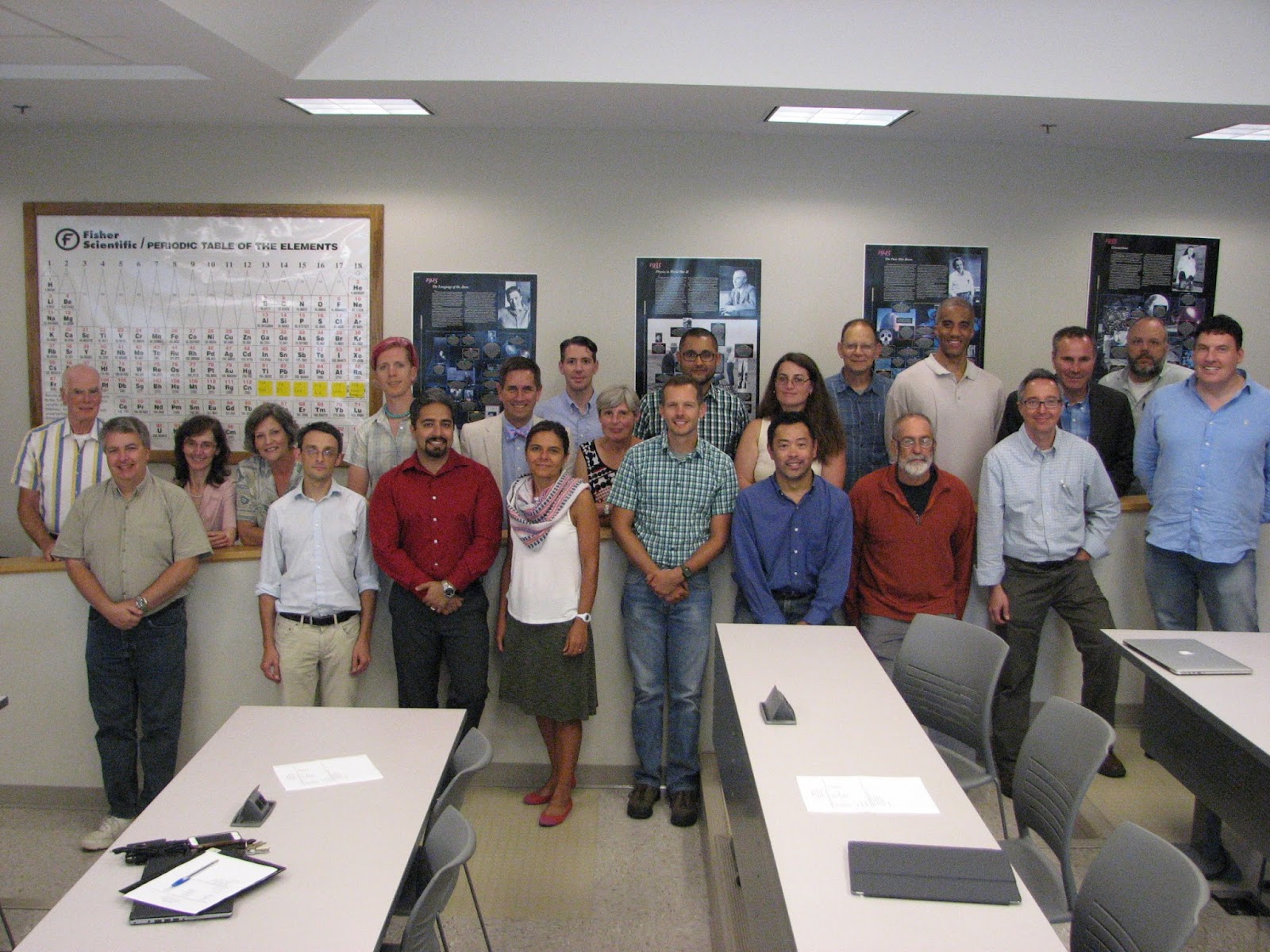
The long meetings before the first day of classes were over, and we prepared our smiles for you to meet us all, on two rows: 


Starting from the back row, from left to right, you see: Herb Slade, Giovanna Scarel, Kim Emerson, Scottie Pendleton, Chris Hughes, Jason Sterlace, Ioana Niculescu, Marcelo Dias, Adriana Banu, Geary Albright, Tahani Finch, Costel Constantin, and Scott Paulson.

Then back on the first row, from right to left, you'll find: Sean Scully, Klebert Feitosa, Kevin Giovanetti, Keigo Fukumura, Jacob Brown,  Anca Constantin, Masoud Kaveh-Baghbadorani, Ilarion Melnikov, and Mark Mattson.

Missing from the photo this year are Harold Butner, Harry Hu, Gabriel Niculescu, Shanil Virani, and Bradley Newcomer.

Steve Whisnant is surely missing us.  You'll believe this so long as you don't check out his blog, about his new chapter.  He is the same funny guy.