Friday, September 23, 2016

Meet the Visitor: Justin Finke, from the Naval Research Labs

Blog 1 Speaker.jpg
The first guest speaker for Seminar this year was Justin Finke, a physicist at the Naval Research Labs, who gave his talk entitled ‘Gravitational Waves from Merging Black Holes and the Connection to Black Holes in Ultraluminous X-Ray Sources.’

Dr. Finke visited us on the day after the first anniversary of the discovery of gravitational waves (an article about this anniversary can be found on LIGO’s website here).  On September 14, 2015, gravitational waves were first detected with the merging of two of black holes. This event happened exactly as general relativity had predicted and additionally lead to the realization that black holes greater than 10 solar masses exist.

Gravitational waves are waves produced by an extremely accelerated mass. Usually these masses are orbiting black holes or neutron stars. Throughout his talk, Dr. Finke mentioned how pulsars (a neutron star that rotates at extremely high speeds) helped to show the existence of gravitational waves, before gravitational waves were observed.  Pulsars can be used because they emit pulses at an extremely regular rate, allowing them to act as a “clock.”

In order to thoroughly investigate gravitational waves, it is important to find the merger rate of Binary Black Holes (BBH). Dr. Finke explained that his work involved inferring the BBH merger rate by looking at the formation of Ultraluminous X-ray sources (ULXs). A ULX is an object which exceeds the Eddington limit, which is supposed to be the maximum brightness that an object in space can have. To some degree this limit is related to metallicity, which for astronomers, means the fraction elements heavier than H or He. The less metallicity a celestial object has, the greater the brightness.

In the future, Dr. Finke and his team hope to find the relationship that links ULXs and metallicity.

After Justin Finke finished his seminar on gravitational waves, we approached him for an interview. Dr. Finke was kind enough to answer the following questions we had for him.

Was your work on gravitational waves done in collaboration with LIGO?

Dr. Finke explained that he was inspired by the LIGO findings when he saw the connection between Ultraluminous X-Ray source formation rate and the Binary Black Hole merger rate, but he did not work together with LIGO.

What were you working on before gravitational waves?

Justin Finke said that he usually works on gamma ray jets shot out by Supermassive Black Holes. Dr. Finke commented that he did this research using the FERMI Gamma Ray Telescope, which circles the globe every 90 minutes in a low-Earth orbit.

Why did you choose to become an Astrophysicist?

Justin Finke joked that he did not have any big story that convinced him to become a physicist; he had always been interested in physics and math, and thought that astrophysics was the most interesting subject to research.

How did you end up working at the Navy Research Lab?

Dr. Finke recounted that, while going for his PhD, he collaborated with someone from the Navy Research Lab. The person Justin Finke worked with helped him get a job at the NRL, and is now Finke’s boss.

Breaking down the interview, Dr. Finke’s comments provide some good advice for aspiring physicists. Pursue the work that interests you, and interact with your fellow physicists. You never know where a work opportunity might come from, or when you’ll find inspiration for an interesting research subject, so always keep an open mind.

Monday, September 19, 2016

CALL FOR NOMINATIONS for the JMU High School Physics Teacher of the Year Award

The Department of Physics and Astronomy at JMU is now accepting nominations for the JMU High School Physics Teacher of the Year Award!!

The award will be given to a high school physics teacher nominated by former students who are currently enrolled or have been enrolled at JMU in STEM majors. The nominee should be an individual who exhibits exceptional dedication to teaching physics and has an outstanding record of going above and beyond in providing education and guidance necessary for the success of the students.

 ALL high school teachers who are nominated will be notified that they have been nominated and by whom.

 NOMINATION DEADLINE: Friday, September 30, 2016

MAKE YOUR NOMINATION here: JMUHighSchoolPhysicsTeacherOfTheYearAward

Friday, September 16, 2016

Our Student Bloggers for 2016-2017: Yvonne Kinsella & Joseph LoPreto


For the 2016-2017 academic year we are rolling with not one, but two student bloggers. There seems to be so much passion for writing this year, some weren't gonna keep those talents hidden.
Let's meet them, in no particular order:

Yvonne Kinsella: is currently a junior physics major here at JMU. Being from Massachusetts, she refers to Dunkin' Donuts as "Dunks" and uses the word "wicked" as an adverb. She claims that JMU has given her the unique experiences of school being canceled for less than an inch of snow and a winter that lasts less than six months. And, of course, so much more: Yvonne is a member of Dr. Hughes' research group and worked as a Learning Assistant for Physics 240 last fall. Now, she is thrilled to have gotten the opportunity to be a writer for the Physics & Astronomy blog.

"Growing up," she says "I always wanted to be a writer. I was writing as early as age nine or ten, and rediscovering things you wrote at age ten when you are nineteen or twenty is a hilarious experience. I also have a love for science; otherwise, I would not be a physics major. I am excited to be able to bring my long time love of writing and my dedication to physics together this school year here on the Physics & Astronomy blog!"


Joseph LoPreto: is a third year student at JMU studying Physics and Secondary Education. He grew up in Front Royal, VA, which is an hour north of Harrisonburg.

 More about him, in his own words: I have always enjoyed science-fiction, and eventually that led me to physics. I just love how diverse the field is, ranging from quantum physics to astrophysics, mechanics to electromagnetism to thermodynamics. Besides that, there are so many fun little experiments you can try in physics, like lighting grapes on fire with a microwave.

Aside from physics, I also really love reading. Going back to the bit about sci-fi, I am currently trying to read as many Philip K. Dick books as I can get my hands on (a popular one you may have heard of is, “Do Androids Dream of Electric Sheep”, which is what the Blade Runner movies are based on).

Other fun facts about him: he did theatre in high school, he has been to Greece, Italy and France, and more recently, he has worked as an intern at Jefferson Labs during the summer of 2016 (and highly recommend any of you other students applying for the SULI internship if you get the chance). He promised a blog post about this particularly enlightening experience.

Tuesday, September 13, 2016

The new and the old: starting again

The 2016-2017 academic year has kept us busy for a few weeks now!  It's been an abundance of new colleagues, classes, and new students to think about and prepare and mentor, and the old stuff that kept us busy during the summer didn't magically disappear. The lab measurements still needed fine tuning, the calculations still needed further testing, the papers and the proposals still needed to be finalized and submitted.  But who's complaining.    

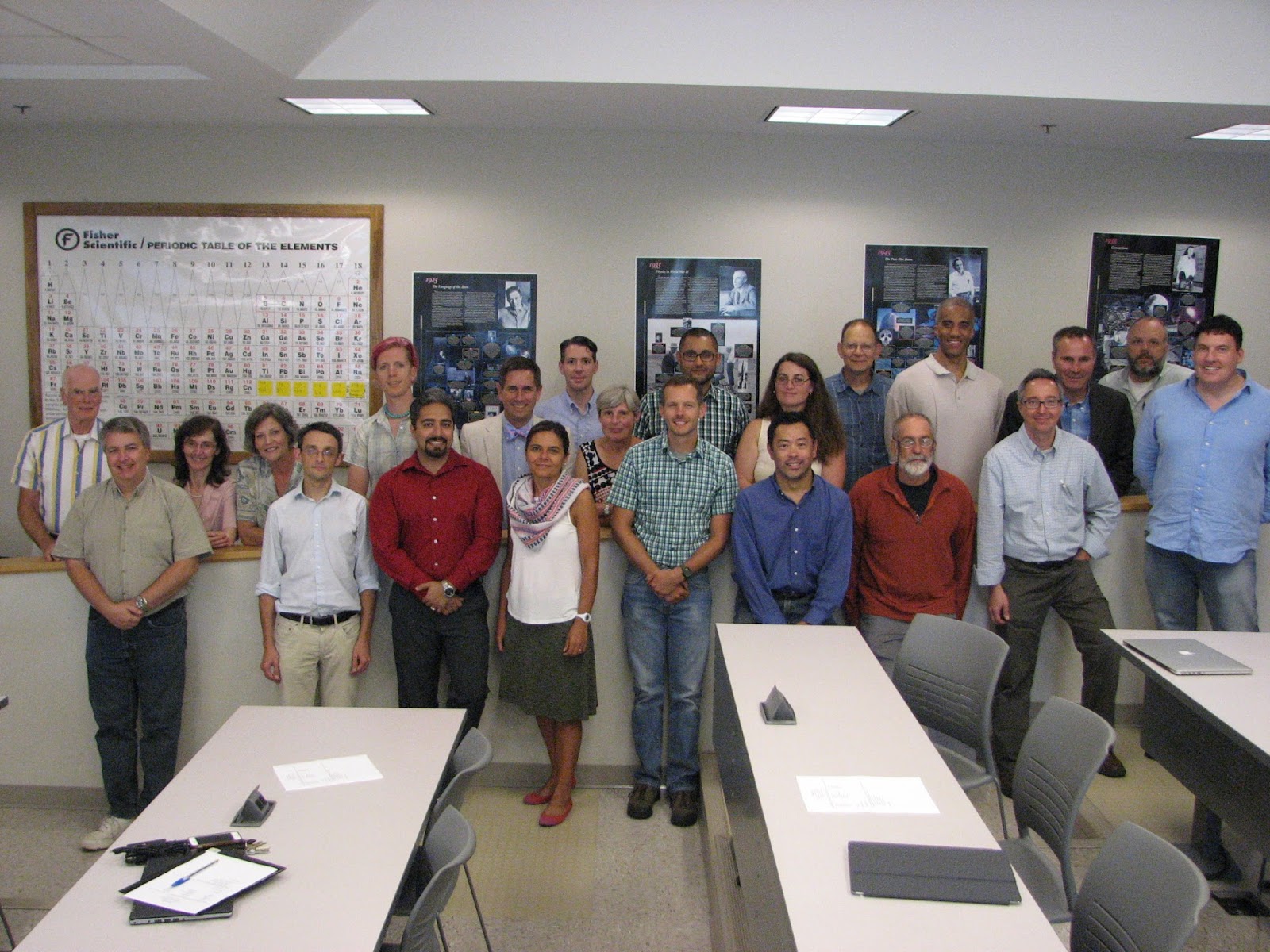
The long meetings before the first day of classes were over, and we prepared our smiles for you to meet us all, on two rows: 


Starting from the back row, from left to right, you see: Herb Slade, Giovanna Scarel, Kim Emerson, Scottie Pendleton, Chris Hughes, Jason Sterlace, Ioana Niculescu, Marcelo Dias, Adriana Banu, Geary Albright, Tahani Finch, Costel Constantin, and Scott Paulson.

Then back on the first row, from right to left, you'll find: Sean Scully, Klebert Feitosa, Kevin Giovanetti, Keigo Fukumura, Jacob Brown,  Anca Constantin, Masoud Kaveh-Baghbadorani, Ilarion Melnikov, and Mark Mattson.

Missing from the photo this year are Harold Butner, Harry Hu, Gabriel Niculescu, Shanil Virani, and Bradley Newcomer.

Steve Whisnant is surely missing us.  You'll believe this so long as you don't check out his blog, about his new chapter.  He is the same funny guy. 

Wednesday, June 08, 2016

A New Chapter Begins


At the end of June 2016, I retire after 15 years as the Head of Physics and Astronomy. I hand the reins of the physics department over to Chris Hughes and Ioana Niculescu, who have agreed to take them, at least for little while. I've had my turn and I have had lots of fun doing it.


Saturday, May 07, 2016

2016 Commencement

HEARTFELT CONGRATULATIONS to the Class of 2016:

Russell Beirne Blair, Daniel Hayes Breysse, Michael Talley Brooks, Devin Eve Buennemeyer, Meagan Alexis Cronin, Zachary Mitchell DeHart, Emily Elizabeth Dick, Jacob David Green, Griffin Quinn Hundley, Josiah K. Lapolla, Justin Huy Le, Evan George Meekins, Erin Delaney O'Brien, David Hans Olson, Jacob Landes Sheets, Jeffrey Lee Small, Thomas Chase St. John, Shawn Dimitri Thomas, Alexander Carl Winkley


Mr. Alger, the president of JMU, and Prof. Hughes carrying the university ceremonial mace


The 2016 Commencement Address to the College of Science and Mathematics by Prof. Scott Paulson 
 

Way to go Class of 2016! SO PROUD OF YOU ALL!

Tuesday, April 12, 2016

JMU at NCUR 2016

On April 6th, JMU sent some our its students down to UNC Asheville to present at the 30th annual National Conference for Undergraduate Research (NCUR).

Among the twelve students sent were four physics majors, listed below with their topic of research.


Catherine Witherspoon ('17) presented her astronomy research with Dr. Anca Constantin via a poster: A Wise Test of Links Between Megamaser Activity and Nuclear Observation.


Hans Olson ('16) presented his materials science research with Dr. Costel Constantin via a poster: Structural and Electrical Characterization of Manganese Oxide Films Deposited by Dc Magnetron Sputtering on Silicon and Sapphire Substrates.


Devin Buennemeyer ('16) presented her material science research with Dr. Christopher Hughes with a presentation: The Design and Fabrication of Microfluidic Devices for Neutron Analysis.


Evan Meekins ('16) presented his medical physics research with Dr. Derek Dolney (University of Pennsylvania Hosptital) with a presentation: Fitting the Bragg Curve: Increasing the Accuracy of Proton Therapy with On-site Data Analysis.


Congratulations to everyone who presented!

2016 Honors Recipients

Many thanks to everyone who was involved in this year's honor banquet and helped honor our amazing students!


Congratulations to the following scholarship recipients:

Premal Patel for receiving the Don E. Chadrow, Physics Alumni, and Henry W. Leap scholarships


Kenneth Gordon for receiving the Raymond A. Serway scholarship


Congratulations to Olivia Cypull, Justin Leas, and Evan Meekins for their performance at the JMU Undergraduate Physics Symposium


Congratulations to the following Physics Awards recipients:

Josiah Lapolla for receiving the JMU Physics Service award


Tyler Stephens for receiving the JMU Physics Teaching award


Daniel Stein for receiving the JMU Planetarium Service award


Evan Meekins for receiving the JMU Physics Research award


Congratulations to Catherine Witherspoon for being honored as the Outstanding JMU Physics Junior


Congratulations to Evan Meekins for being honored as the Outstanding JMU Physics Senior


And congratulations to all of the students who were inducted into Sigma Pi Sigma.  It is an honor to share in the same academic fraternity as you all (listed below)!

Russel Blair
Dan Breyesse
Meagan Cronin
Emily Dick
Kenneth Gordon
Josiah Lapolla
Erin O'Brien
Premal Patel
Jeffrey Small
Catherine Witherspoon

Monday, April 11, 2016

Honors Banquet 2016

Dr. Ioana Niculescu presenting the Outstanding Senior award to Evan Meekins.

On the evening of April 6, 2016, we celebrated the achievements of our outstanding students again this year.  You can see photos the attendees and all the recipients at this link.


Sunday, March 27, 2016

2016 Physics Undergraduate Symposium

On Saturday, March 26th, the undergraduates of JMU Physics presented their research in front of their professors and colleagues.  Listed are those who presented, their research professor, and what topic they presented on.

Angelica Watson
Dr. Adriana Banu
Studying the (α,p)-process in X-ray bursts using rare isotope beams


Evan Meekins
Dr. Derek Dolney & Dr. Adriana Banu
Fitting the Bragg Curve: Increasing the Accuracy of Proton Therapy with On-Site Data Analysis


Brian Seymour
Dr. Klebert Feitosa
Interfacial Bubble Deformations


Jason Ferguson
Dr. Anca Constantin
Searching for Accreting Supermassive Black Holes in Bulgeless Galaxies


Jacob Green
Dr. Anca Constantin
Exploring Long-Term Variability in Active Galactic Nuclei Via Monte Carlo Simulations of Optical Spectra


David H. Olson
Dr. Costel Constantin
Structural and Electrical Characterization of Amorphous and Crystalline Manganese Oxide Thin Films Deposited by DC Magnetron Sputtering


Justin M. Kaczar
Dr. Giovanna Scarel & Dr. Brian Utter
Effect of Angle Dependence on the Electric and Entropic Contributions of Infrared Power Generation


Thomas St. John
Dr. Giovanna Scarel
The effects of infrared radiation power variation on infrared power generation


Griffin Hundley
Dr. Sean Scully
Searching for Traces of Planck-Scale Physics with High Energy Gamma Rays


Justin Leas
Dr. Keigo Fukumura
X-ray Photoionization of Magnetically-Driven Accretion-Disk Winds


Olivia Cypull
Dr. Klebert Feitosa
Droplet Dynamics of a Flowing Emulsion System


Ian Davenport
Dr. Ilarion Melnikov
Classification of Landau-Ginzburg Theories

Josiah Lapolla
Dr. Dana Longcope & Dr. John Unverferth
Modeling the Effects of Magnetic Field Variation on Solar Flares


Sean Scro
Dr. Keigo Fukumura
Spectroscopic Modeling of X-ray Absorbers in the Transient Black Hole Binary GRO J1655-40


Aidan Gordon
Dr. Giovanna Scarel & Dr. Brian Utter
Modeling Chaotic Phenomena


Many thanks to everyone who presented!

Gliding Through the Last Demystifying the Expert

Last Thursday (March 24th), Dr. Anca Constantin and Dr. Klebert Feitosa hosted New & Improv'd and Dr. Roshna Wunderlich for the last "Demystifying the Expert" of the 2015-2016 school-year.


The evening started off well with a 20 questions-esque game where the improv team had to guess Dr. Wunderlich's professional title and research topic.  Several guesses included, but were not limited to, "Can it be found in Disney World?  In the hearts and minds of children?", "Is it us?  A young body like mine?  Inside us?!", and "Is it that thing Dr. Frankenstein used to bring his monster back to life?" 

After a series of laughs, the audience learned that Dr. Wunderlich is a professor in Biology and head of the JMU Women's Rugby Team.  She also researches the behavioral patterns of societal interactions of lemurs.  She does so in the prospect of learning the secrets of their longevity, and perhaps apply that knowledge to expanding the human lifespan.  Many think that their heightened lifespan has to do with the fact that they hibernate for seven months, which could also help humans in the field of space travel in regards to cryostasis.


When asked how they endure this, Dr. Wunderlich explained that they store the food as fat in their tail, which warranted a "junk in the trunk" reference and possible qualifications for future astronaut candidates.  Dr. Wunderlich then talked about how her team tracks the lemurs with fitbits and magnetic field positioning techniques, as well as their interactions with their children.  She also described the lemur mating season as "like Spring Break in Tampa," with the improv group adding, "That must be the craziest three days ever!"

Further discussing lemurs, the improv teamed asked how they lemurs respond when Dr. Wunderlich's team interacts with them.  She answered, "We just blowdarted them out of a tree, how do you think they feel?"  When asked if she hunted them, Dr. Wunderlich responded, "No we have a guy who's really good with a blow dart.  We just catch them when they fall."

The event concluded with the improv group guessing several biological acronyms/terms, as well as the 2-truths & 1-dare game.  This led to great discussions about how mother lemurs jump from tree to tree with their babies attached to them, healthcare costs for the average lemur, and the differences between Rugby and common terminologies.

Thank you to everyone involved in the last Demystifying the Expert of the year!