
Monday, September 28, 2015
Atomic Layer Deposition: Russia 2015
On September 21-23 2015, Dr. Scarel participated to the Symposium on Atomic Layer Deposition: Russia 2015. The event took place in Moscow and was hosted by the Moscow Institute of Physics and Technology. Dr. Scarel was invited to present her research on “Atomic layer
deposition for rare earth oxides and thermoelectric thin films”. She described her research before joining JMU and her research at JMU with our undergraduate students. The symposium is historic in the Atomic Layer Deposition field because for the first time the Russian, European, and North American ALD teams confronted each other face-to-face. Below is a picture of the participants. Dr. Scarel is on the top row, toward the left ..... in the middle of the crowd.


Sunday, September 20, 2015
"You're the Expert" with Dr. Anca Constantin
This past Thursday, our own Dr. Anca Constantin joined a gut-busting troupe of comedians at the Court Square Theatre for “You’re the Expert,” with Chris Duffy.
Along with Duffy and Dr. Constantin, the comedy cocktail included Anna Drezen, the associate editor of Reductress, Maeve Higgins from Inside Amy Schumer, and Nick Vatterott of Comedy Central.


Throughout the night, the comedians had to guess at topics such as Dr. Constantin’s title, research focus, personal life, and various astronomy terms and acronyms. Laughter rang aloud throughout the night, with jokes including astronauts with space shotguns and space whiskey, the ethics of interplanetary affairs, and that the Bootes Void is right under Orion’s Belt.


Despite the ensemble of laughter, the night was dedicated to the integration of comedy with education. While there were educational aspects within much of the comedy, such as highlighting the difference between astronomy and astrology, proper time was dedicated to focus in on Dr. Constantin’s experience as an Astronomer and Professor. During this time, she touched on what inspired her, the current state of astronomy, and the potential of her research.

If the comedians on stage gave any indication of the audience (both of whom didn’t have any previous knowledge on the subject), then everyone was thoroughly intrigued by the vastness and wonder of astronomical research. We thank Chris, Nick, Maeve, and Anna for coming to Harrisonburg to make us laugh while we learn, and learn while we laugh.
Talking Physics with Chris Duffy of NPR's "You're the Expert"
We've all been there: you're reading a textbook when, suddenly, the word “Clearly” precedes an equation that came straight out of left field. You question where this came from, why and if this matters, and even your own intelligence. More often than not this is exactly how our friends and loved ones feel when we try to talk to them about our Newtonian passions.

Chris Duffy, host of “You’re the Expert,” knows the value and challenge of communicating scientific ideas with those outside of the academic bubble. On his radio show, Duffy hosts a conversation between a professor and several comedians, making the learning experience more available through comedy.

Chris Duffy, host of “You’re the Expert,” knows the value and challenge of communicating scientific ideas with those outside of the academic bubble. On his radio show, Duffy hosts a conversation between a professor and several comedians, making the learning experience more available through comedy.
The Department hosted Duffy for this week’s seminar, which
was an interactive workshop on how the students and faculty can better engage
the general populous with scientific thought.
This included recognizing audience mannerisms, maintaining a proper
communication link, and the importance of answering questions authentically.
These are certainly skills that we, as members of the
scientific community, must be familiar with, both in the classroom and
outside. We thank Chris Duffy for coming
to James Madison to make us laugh, remind us of the importance of public
outreach, and teach us how to do both!
You can listen to previous entries of Chris Duffy’s
“You’re the Expert” for free in the Podcast section of iTunes, Stitcher, and SoundCloud,
with new episodes added semiweekly!
Saturday, September 19, 2015
Meet This Year’s Student Blogger: Evan Meekins
The newly (last year’s) established tradition, to have a student blog for this house (department, that is) continues this year with… Evan Meekins. We bid Keely fair well in her new journey into graduate school in physics at Emory University.

Evan was an easy and rather obvious choice, albeit from among a few passionate applicants for this position. Evan is a published author. "The Black Banner" is his first book, and fans of fantasy fiction and those new or unfamiliar to the genre are strongly encouraged to give it a read. He confesses that this is only the first in a series of fantasy fiction novels which revolve around the fictional land of Verden amidst, obviously, quite a variety of enchanting adventures. Here is a good place to start.
You have read about his accomplishments in nuclear astrophysics here and here. He spent last summer as a SUPERS at University of Pennsylvania as one of the interns in this prestigious undergraduate program for educating radiation scientists.
He plans to enchant us with a post per week. Nevertheless, chances are we might see more than that from him. He seems unstoppable. While, in his own words, the work ethic of a student author cannot be a game of “catch-up”, but rather it needs need to be a “finish ASAP” mentality in order for any real time to be given to writing, he wholeheartedly applied for this position, and he is on a roll on this new endeavor.
We had an unusual visit for our seminar last week, and Evan’s first post with impressions about this (double) event is coming soon. Get ready for yet another fantastic ride on News and Feats from JMU’s Physics and Astronomy Department.
Saturday, September 05, 2015
JMU Physics Faculty lecturing at an International Nuclear Physics Summer School
Dr. Adriana Banu has been invited recently to give lectures at the 2nd NUBA International Nuclear Physics Summer School organized by the Akdeniz University, in Antalya, Turkey. The topic of Dr. Banu's lectures was primarily focused on Analog and Digital Electronics in Nuclear Physics Experiments.
During her stay at the the Akdeniz University, Dr. Banu also took the opportunity to visit their local clinical electron linear accelerator, a bremsstrahlung research facility similar to the JMU's Madison Radiation Laboratory scheduled now to become accessible in the Madison Hall by Fall of 2016.


Madison
Hall making it one of the very few undergraduate departments in the
nation to have an on-campus nuclear physics facility. - See more at:
http://www.jmu.edu/events/research/2015/10/01-event-innov-art-scholar-celeb.shtml#sthash.H8BKwCUe.dpuf
Madison
Hall making it one of the very few undergraduate departments in the
nation to have an on-campus nuclear physics facility. - See more at:
http://www.jmu.edu/events/research/2015/10/01-event-innov-art-scholar-celeb.shtml#sthash.H8BKwCUe.dpuf
Madison
Hall making it one of the very few undergraduate departments in the
nation to have an on-campus nuclear physics facility. - See more at:
http://www.jmu.edu/events/research/2015/10/01-event-innov-art-scholar-celeb.shtml#sthash.H8BKwCUe.dpuf
Sunday, August 30, 2015
The annual gathering

The 2015-2016 academic year has begun! Above you see arrayed before you eyes the collection of folks who are going to make it all happen.
After a long morning of meetings, we gather on the steps to the biology building for a quick snap of the faculty and staff.
Missing from the photo this year are Adriana Banu, Geary Albright, and Scott Paulson.
Starting from the back row, left-to-right are (clear rows are hard to make out so my list is likely a bit funky):
-Shanil Virani, Harold Butner, Sean Scully
-Giovanna Scarel
-Gabriel Niculescu, Keigo Fukumura
-Kim Emerson, Chris Hughes, Mark Mattson, Ioana Niculescu, Costel Constantin, Bradley Newcomer
-Thomas O'Neil, Jacob Brown, Kevin Giovanetti, Ilarion Melnikov
-Milka Nikolic, Herb Slade, Klebert Feitosa, Anca Constantin, Steve Whisnant
New to the department this year are Jacob Brown, the laboratory manager; Ilarion Melnikov, our string theorist; and Bradley Newcomer, the new Director of the Honors Program.
Plenty of seasoned hands to move us along. Promises to be a great year.
Thursday, August 20, 2015
Summer days at JLab
From June 2nd through the 5th and 17th through the 18th, and on August 3rd, Dr.
Gabriel Niculescu, accompanied by the students Alex Winkley, Justin Le, and Wayne Morris,
worked together on a project at Jefferson Lab in Newport News, Virginia. Jefferson Lab, also
known as JLab, is a national accelerator facility funded by the U.S. Department of Energy. The
lab seeks to research and gather information regarding the atom’s nucleus, more specifically its
structure, using the lab’s particle accelerator known as the Continuous Electron Beam
Accelerator Facility (CEBAF). The lab houses scientists from around the world as well as
graduate and undergraduate students from across the country.
The JMU PNP team took a total of three trips to JLab and in that time they managed to install two frames with scintillators and photomultiplier tubes (PMTs) for the Super High Momentum Spectrometer (SHMS) to be used in Hall C at JLab. Scintillators are used to detect ionizing radiation from particles that pass through them and are wrapped with a reflective material. When these particles pass through the scintillators they produce photons that bounce around (due to the reflective material) until they reach the ends where the PMTs are located. Once the photons reach the Photomultiplier tubes, they utilize the photoelectric effect to convert the light produced into an analog signal.
The JMU PNP team took a total of three trips to JLab and in that time they managed to install two frames with scintillators and photomultiplier tubes (PMTs) for the Super High Momentum Spectrometer (SHMS) to be used in Hall C at JLab. Scintillators are used to detect ionizing radiation from particles that pass through them and are wrapped with a reflective material. When these particles pass through the scintillators they produce photons that bounce around (due to the reflective material) until they reach the ends where the PMTs are located. Once the photons reach the Photomultiplier tubes, they utilize the photoelectric effect to convert the light produced into an analog signal.
These scintillators are mounted on two separate frames and the frames are positioned
roughly 5 meters away from each other. The scintillators are attached to the frame in two
layers, one layer oriented horizontally and the other vertically, forming a mesh, so that no
charged particles can pass through undetected. This setup is good for getting an accurate time
of flight of the particles that pass through.
 Upon completion of mounting the scintillators/PMTs to the frames, the team also had to
test the PMTs to see if they could produce a strong signal. In order to accomplish this, a high
voltage power supply was connected to a PMT via a coaxial cable, and then the PMT was
connected to an oscilloscope via a second coaxial cable. As the PMTs came from two different
sources, it was necessary to vary the supply voltage depending on the PMT’s peak efficiency,
1200 V for one source and 1500 V for the other. A good signal is characterized by a high signal to noise ratio and a high amplitude on the oscilloscope. Pictured below is an example of an
ideal signal on an oscilloscope.
Due to concern of light leaks in some of the scintillators, the team had to head back to
JLab one more time on August 3rd. These light leaks are spots on the scintillators where
photons produced from an external source are able to enter the scintillator and, as a result, fill
the signal with so much noise that the data coming from the signal is useless. A light leak is
easy to fix; an application of electrical tape in the leaking area fixes the leak just fine. The
difficulty comes with finding all of the possible light leaks, of which there were numerous on the
PMTs the team had to work on. The origin of the light leaks appeared to be a result of a design
flaw with the way the scintillator was attached to the PMT. However, by the end of the day, a
system had been developed and the team was able to pinpoint where light leaks existed
consistently from one PMT to another.
Wednesday, June 24, 2015
Infrared radiation, Thermoelectricity and Chaos
On Wednesday June 17 2015 JMU hosted the
Workshop entitled “Infrared Radiation,
Thermoelectricity and Chaos”. Dr. Giovanna
Scarel was the co-organizer with Benjamin Delp, Director of JMU Research
Development and Promotion. The Workshop discussed
Dr. Scarel’s infrared power generation and featured two international
speakers. Prof. Giulio Casati of Italy spoke
about Conservation laws, symmetry
breaking and control of the heat current.
Prof. Francisco Javier Gonzalez Contreras of México
described Seebeck nanoantennas for solar
energy harvesting. Three speakers
represented the U.S.A. academic world. Prof.
Gabriel A. Rincón-Mora of the Georgia
Institute of Technology, presented Microwatt CMOS
harvesters. Prof. Rajeevan Amirtharajah of the University
of California at Davis, discussed on Powering
systems from ambient energy sources.
Finally, Prof. S. Joseph Poon of the University of Virginia, presented Practical realization
of ZT>1 from the materials perspective. The business and entrepreneurial world was
represented by Dr. Ronald J. Parise of Parise Research Technologies, who
introduced The Nighttime solar cell®: infrared energy to deep
space. Dr. Joseph R. Blandino of the
Virginia Military Institute, and Dr. David J. Lawrence of James Madison
University, presented a poster on Transient
response of a thermoelectric generator subjected to spatially non-uniform
heating: implications for heat and IR sensing applications. In her presentation Dr. Scarel explained the
connection among the words in the title of the Workshop.
Two posters were presented by JMU
Physics students Graham Gearhart and Brian Lang. Graham presented “Infrared source and thermoelectric device trends in infrared power
generation”, while Brian discussed: “The interaction between current and infrared
radiation”. Graham and Brian are
part of the Scarel’s research group.
Other JMU students joined the event asking questions and networking.
Dr.
Brian Utter (Physics, JMU) and Lynn Petersen (U.S. Office of Naval Research)
chaired the morning and the afternoon sessions.
Dr. Yvonne Harris, vice Provost for Research and Scholarship, and Lynn
Petersen opened the event in the morning and addressed the final remarks in the
afternoon, respectively.
The
Workshop was funded by the U.S. Office
of Naval Research, the 4-VA Consortium, JMU, and The Madison
Trust—Fostering Innovation and Strategic Philanthropy.
The
picture below shows a moment of the event.

Saturday, May 09, 2015
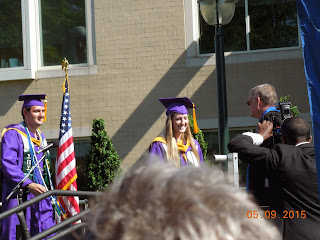
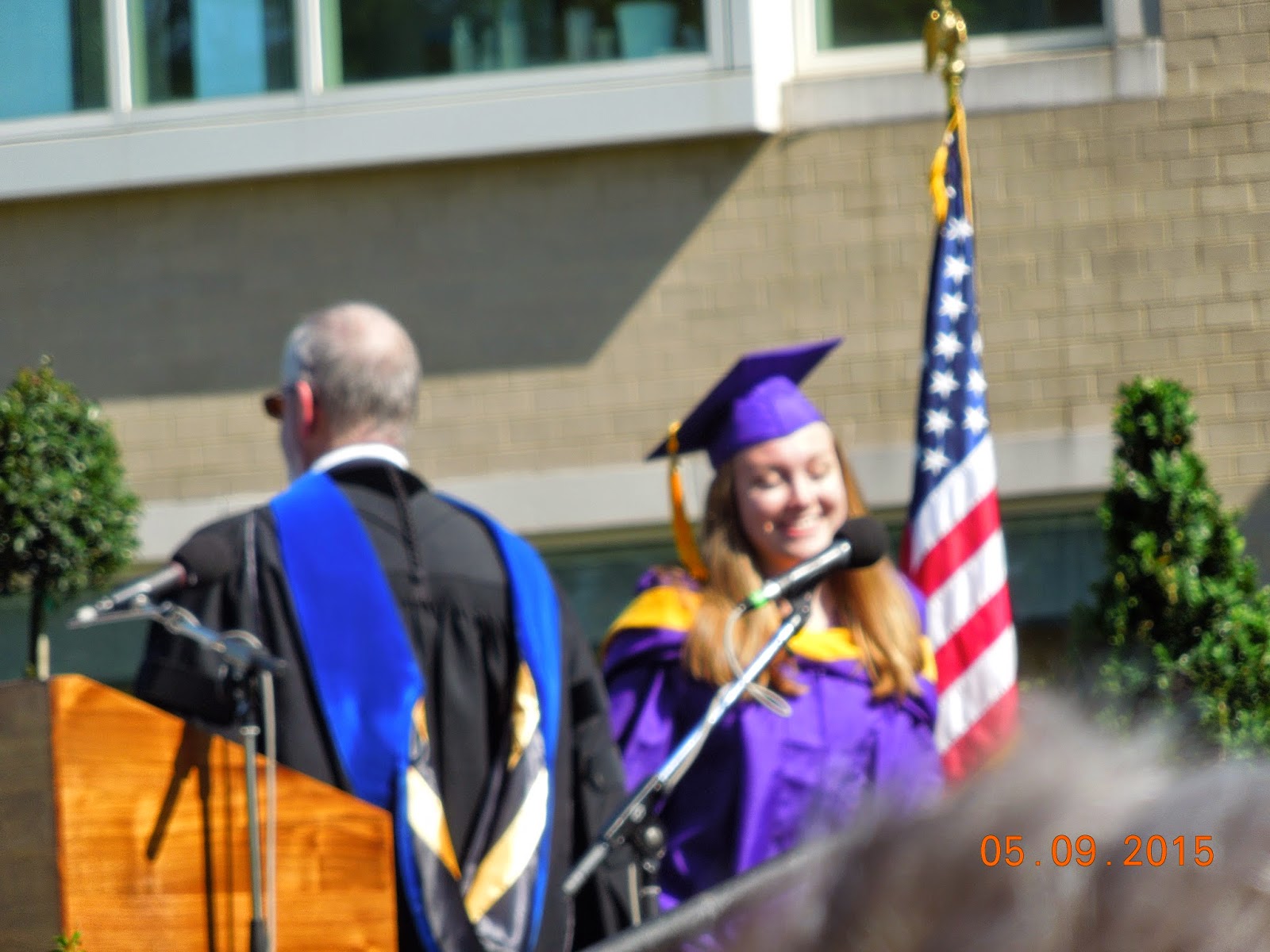
Congratulations Class of 2015! Once a Duke always a Duke...
Well done all of our physics majors who graduated today, May 9th, 2015:




- James McDermott Barney, B.S.
- Christopher Andrew Castillo, B.S.
- Peter Gregory Clark, B.S.
- Nicole Christine Creange, B.S. (cum laude, graduating with distinction)
- Keely Ryan Criddle, B.S. (graduating with distinction, service award)
- Joshua John Dunbar, B.S.
- Graham Perry Gearhart, B.S.
- Morgan Elizabeth Hedden, B.A. (graduating with distinction)
- Seth Alexander Heerschap, B.S. (graduating with distinction)
- Gregory Michael Houchins, B.S. (magna cum laude)
- Kevin Sean Hunter, B.S.
- Alexandra Teodora Iuga, B.S.
- Kirill Olegovich Korsak, B.S. (magna cum laude)
- Brian Nicholas Lang, B.S.
- David Alexander Loving, B.S. (magna cum laude)
- Harkirat Singh Mann, B.S.
- Wayne Henry Morris III, B.S.
- Andrew R. Nutter, B.S.
- Galen Wolcott Richard, B.S.
- Yosyp Schwab, B.S.
- Daniel Calvert Shorts, B.S.
- Daniel Gregory Jenks Votaw, B.S. (magna cum laude, research award))
- Colleen May Wallace, B.S. (magna cum laude/outstanding senior)
- George Cross Wilkes, B.S.
- Meris Victoria Yates, B.S.




Sunday, May 03, 2015
Links for the Love of Physics!
With the semester coming to an end and the impending doom of not having physics classes for the next few months becoming ever-increasing, fear not - for through the internet your love of all things physics can be nurtured all season long.
Make A solar system and watch it crumble over millions (or sometimes thousands) of years.
Watch some fun and educational videos.
Learn more about those SI units we adore.
Check out NASA's Astronomy picture of the day.
Read about how the everyday things we use were made.
Watch a video on the physics of comic books.
Enjoy this PBS Documentary about Feynman.
Revel in the awesomeness of some of Lewin's best lines.
Check out NPR's You're the Expert (Coming to JMU this fall!!).
-Keely Criddle
JMU Physics & Astronomy Blogger
 |
| Source |
You may want to take a moment and note today’s date. This just
might be the day you’ll recount to your grandchildren when they complain about
the energy bill in their first studio space-apartment.
 |
| Source |
Anyways, yes, what I just said is an actual possibility given
what’s being put on the table: a virtually unlimited, zero-emission energy
source. Making it even more of an actual possibility is from whom that promise
is coming from: Lockheed Martin’s Advanced Development Programs, better known
as the Skunk Works. Past projects include: the P-80 Shooting Star , the first
fighter jet the USAF deployed over the skies of Korea; the U-2 spyplane, famous from its
eponymous “incident”; and of course, the rockstar: the SR-71 Blackbird. Not a pedigree
to scoff at to say the least. With the Skunk Works’ history of doing what can’t
be done, and quickly to boot, this makes for extremely exciting news.
Maybe the first thing
that came to mind when I said, “virtually unlimited, zero-emission energy
source” was wind power, maybe tidal, or perhaps solar, but the answer is
actually nuclear. Nuclear fusion, that is. Unlike nuclear fission, where one
atom splits into two and releases energy as a result, nuclear fusion, when two
atoms fuse into one, is not commercially employed in any nuclear power plants.
That’s because the energy from fission reactions is relatively simple to
harvest compared to fusion.
 |
| Source |
So, in fission reactors (pictured above) the source of heat for
steam turbines comes from the fission of radioactive elements such as uranium
and plutonium, where the rate of fission can be manipulated through control
rods which absorb neutrons that would have split more uranium atoms. Fusion
reactors, on the other hand, involve recreating conditions akin to the core of
our sun, which is to say, a lot of
heat and a lot of pressure. If we
were to peer into the sun’s core, we’d see superheated gas is separate into its
ions and electrons. Subsequently, when the ions get hot enough, they can
overcome their mutual repulsion and collide, fusing together. According to
Lockheed’s page, “When this
happens, they release a lot of energy – about one million times more powerful
than a chemical reaction and 3-4 times more powerful than a fission reaction.”
With that amount of energy at humanity’s disposal, the entire technologic and
economic landscape changes. Today’s science fiction pipe dreams could become tomorrow’s
kickstarter projects.
 |
| Source |
Now, a team headed by MIT graduate Thomas McGuire, seen above
with a compact fusion prototype, is attempting to create a compact,
100-megawatt fusion reactor; enough power for a small city of 50-100k people.
McGuire and his team diverge from the fusion community’s first attempt at
fusion power, the tokamak design (the same design being used in ITER), instead opting for a high beta concept that “uses a high fraction of the magnetic
field pressure, or all of its potential, so we can make our devices 10 times
smaller than previous concepts.”
 |
| Source |
A goal, if achieved, would change the world in as we know it.
We’re talking clean, limitless energy with no lingering radioactive waste, no
risk of proliferation, all in a transportable form factor. Suddenly, daunting
problems like providing clean water and electricity to the whole world becomes
a lot more palatable. Looking beyond the scope of our planet, adding fusion
energy into the mix with space travel nets shorter travel times, crucially
cutting down on radiation exposure during transit. And with space travel, comes
colonization, mining operations, and a
third-thing-you’ve-seen-in-space-movies-that-you-always-wished-was-real.
The dream of cheap, green, and plentiful fusion energy, if
realized, would undoubtedly become the catalyst for the next great human
revolution, the true vision of the atomic age our scientists since the 50s
could only envision in their dreams.
Check out the source for more technical information on the
Skunk Work’s Compact Fusion project.
-Alan Chen
Guest Blogger
Friday, May 01, 2015
JMU's presence at international workshop in particle & nuclear physics
Every year the particle and nuclear physicists, experimentalist and theorists alike gather together for a weeklong workshop to discuss the latest developments in Deep Inelastic Scattering and related processes.
This year more than 200 physicists representing a plethora of international labs: LHC, KEK, RHIC, Fermilab, JLab, DESY are meeting (April 27 to May 1) at the XXIII DIS 2015 International Workshop at Southern Methodist University in Dallas Texas. The JMU Physics and Astronomy's Particle and Nuclear Physics Group (JMU PNP) were major contributors to several of the talks presented, including a talk on quark-hadron duality on the neutron delivered by Dr. Gabriel Niculescu (see photo). As the conference started, JMU PNP members were informed that their paper on q-h duality on the neutron was accepted for publication in Physical Reviev C (PRC).

This year more than 200 physicists representing a plethora of international labs: LHC, KEK, RHIC, Fermilab, JLab, DESY are meeting (April 27 to May 1) at the XXIII DIS 2015 International Workshop at Southern Methodist University in Dallas Texas. The JMU Physics and Astronomy's Particle and Nuclear Physics Group (JMU PNP) were major contributors to several of the talks presented, including a talk on quark-hadron duality on the neutron delivered by Dr. Gabriel Niculescu (see photo). As the conference started, JMU PNP members were informed that their paper on q-h duality on the neutron was accepted for publication in Physical Reviev C (PRC).
Friday, April 24, 2015
Physics Majors outnumbered the JMU delegation at the 2015 National Conference on Undergraduate Research!
The 2015 National Conference on Undergraduate Research (NCUR) took place at Eastern Washington University in Cheney, WA from April 16-18.
JMU was represented by 11 undergraduates among which seven students were Physics Majors, as follows:
JMU was represented by 11 undergraduates among which seven students were Physics Majors, as follows:
- Christopher Castillo - "Building the most robust catalog of voids and void galaxies" (research adviser: Dr. Anca Constantin)
- Nicole Creange - "Surface science analysis of Gallium Oxide deposited on Gallium Nitride semiconductor" (research advisers: Drs. Jason Haraldsen and Costel Constantin)
- Charles Crook - "Understanding superexchange correlations in magnetically doped graphene" (research adviser: Dr. Jason Haraldsen)
- Gregory Houchins - "Simplifying magnetic dimer calculations" (research adviser: Dr. Jason Haraldsen)
- Galen Richard - "Variational calculations for spin canting at complex oxide interfaces" (research adviser: Dr. Jason Haraldsen)
- Daniel Votaw - "Finding optimal parameters for use of position-sensitive ionization chamber" (research advisers: Drs. Dan Bardayan (University of Notre Dame) and Adriana Banu (JMU))
- George Wilkes - "Plate tracking for a granular Casimir effect" (research adviser: Dr. Brian Utter)
Thursday, April 23, 2015
Talk at NRL
On April 16, 2016 Dr. Scarel visited the U. S. Naval Research Laboratory (NRL) in Washington and presented Infrared power generation: physics and applications. The presentation described the work of Dr. Scarel with collaborators and JMU undergraduate students: Yosyp Schwab, Graham Gearhart, Brian Lang, Harkirat Mann, Kyle Britton, Justin Kaczmar, Zach Marinelli, and Aidan Gordon. The group hopes to establish a research collaboration with the researchers at NRL, where many opportunities are available.
The figure below introduces the nano-power generator, fabricated in 2014 by Harkirat and Brian.

Sunday, April 19, 2015


Saturday, April 04, 2015
JMU Physics Majors doing research in Nuclear Physics attended the 13th Annual Colonial Academic Alliance Undergraduate Research Conference!
The Physics and Astronomy Department at JMU was represented by two physics majors - Wayne Morris (senior) and Evan Meekins (junior) - at the 13th Annual Colonial Academic Alliance Undergraduate Research Conference that took place at Drexel University (PA), March 27-29, 2015.
Both our physics majors did a great job showcasing their undergraduate research work: Wayne Morris (research advisers Drs. Ioana and Gabriel Niculescu) had a poster presentation entitled "Dark current, gain and wavelength testing of PMTs for the gas ring imaging Cherenkov detector" while Evan Meekins (research adviser Dr. Adriana Banu) had an oral presentation entitled "94Mo(g,n) cross section measurements towards understanding the origin of p-nuclei".
Kathleen Krist (Chemistry major), doing research in the field of materials science under mentorship of our own Dr. Christopher Hughes, also had a great oral presentation at this year's CAA Undergraduate Research Conference. The title of her presentation was "The utilization of chloroform post-treatment to improve the adhesion of Au thin film onto PMMA".
JMU was represented overall by a large delegation of 9 students (2 from Physics and Astronomy, 1 from Anthropology, Media Arts & Design, 1 from Biotechnology, 1 from Chemistry, 2 from Public Policy & Administration, 1 from History, and 1 from Biology). Dr. Marta Bechtel (Biotechnology) and Dr. Adriana Banu (Physics and Astronomy) served as the two chaperones of the delegation.
We were very honored to have with us also Dr. A. Jerry Benson - JMU's Provost & Senior Vice President for Academic Affairs, who was very impressed with the performances of our Dukes:
Thanks to all of you for your stellar performance at the CAA Undergraduate Research Conference. You were such great representatives of all the students at JMU and our university as a whole. It was my pleasure to have a little bit of time to be with you. Best of everything as you move toward the end of the semester. And a special thanks to Drs. Bechtel and Banu for your caring leadership and mentoring.
A. Jerry Benson
Provost
Both our physics majors did a great job showcasing their undergraduate research work: Wayne Morris (research advisers Drs. Ioana and Gabriel Niculescu) had a poster presentation entitled "Dark current, gain and wavelength testing of PMTs for the gas ring imaging Cherenkov detector" while Evan Meekins (research adviser Dr. Adriana Banu) had an oral presentation entitled "94Mo(g,n) cross section measurements towards understanding the origin of p-nuclei".
Kathleen Krist (Chemistry major), doing research in the field of materials science under mentorship of our own Dr. Christopher Hughes, also had a great oral presentation at this year's CAA Undergraduate Research Conference. The title of her presentation was "The utilization of chloroform post-treatment to improve the adhesion of Au thin film onto PMMA".
 | |||
| Wayne Morris (senior) during a poster session at the CAA 2015 Undergraduate Research Conference at Drexel University |
 | |
| Evan Meekins (junior) presenting at the CAA 2015 Undergraduate Research Conference at Drexel University |
JMU was represented overall by a large delegation of 9 students (2 from Physics and Astronomy, 1 from Anthropology, Media Arts & Design, 1 from Biotechnology, 1 from Chemistry, 2 from Public Policy & Administration, 1 from History, and 1 from Biology). Dr. Marta Bechtel (Biotechnology) and Dr. Adriana Banu (Physics and Astronomy) served as the two chaperones of the delegation.
 | |||
| JMU delegation at the CAA 2015 Undergraduate Research Conference, Drexel University |
We were very honored to have with us also Dr. A. Jerry Benson - JMU's Provost & Senior Vice President for Academic Affairs, who was very impressed with the performances of our Dukes:
Thanks to all of you for your stellar performance at the CAA Undergraduate Research Conference. You were such great representatives of all the students at JMU and our university as a whole. It was my pleasure to have a little bit of time to be with you. Best of everything as you move toward the end of the semester. And a special thanks to Drs. Bechtel and Banu for your caring leadership and mentoring.
A. Jerry Benson
Provost
Sunday, March 22, 2015
JMU Physics Launches Bottle Rockets at Raw Learning in Staunton!
 |
| JMU Physics & Astronomy seniors Keely Criddle (left) and Nicole Creange (right). |
On Friday, March 20, two JMU Physics seniors -- Keely Criddle and Nicole Creange -- joined John C. Wells Planetarium Director Shanil Virani at Raw Learning in Staunton bright and early! Ok, it wasn't so bright, as there was a persistent drizzle of cold rain, but it definitely was early. Nevertheless, the order of business this morning was to construct bottle rockets using 1L bottle (or 1.5L or even a 2L!), cardboard, construction paper, and LOTS of duct tape! Our fuel was frozen CO2 (aka "dry ice") and water!
Raw Learning is a private school/homeschool learning resource center located on the campus of the Virginia School for the Deaf and Blind. Many of their students were eager to participate in this engineering exercise and learn what variables affect spaceflight (mass, aerodynamics, amount of water, dry ice, etc).
Here are some of their designs!


Of course, once constructed, we now need to launch these bottle rockets! The videos are in SLOW-MOTION so you get the full effect of the tension at mission control as they wondered how their design would fare!
Subscribe to:
Posts (Atom)